Desert Time

As winter approached, we headed south. Outside of Tucson, we chose the highly recommended Gilbert Ray Campground as basecamp for a visit to Saguaro National Park.

img_4653

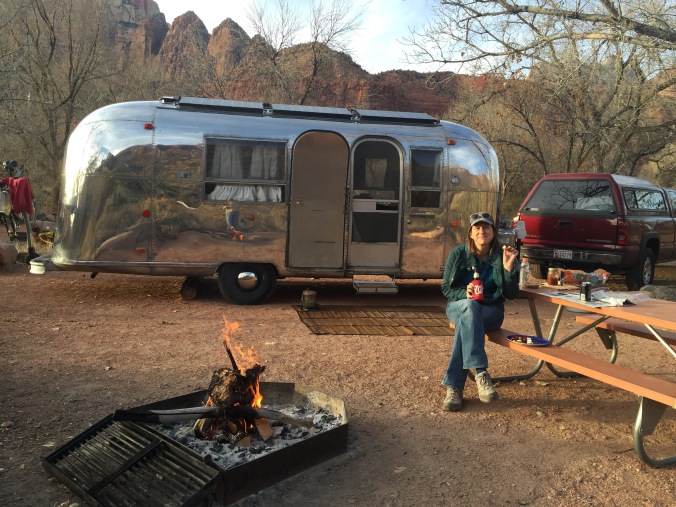
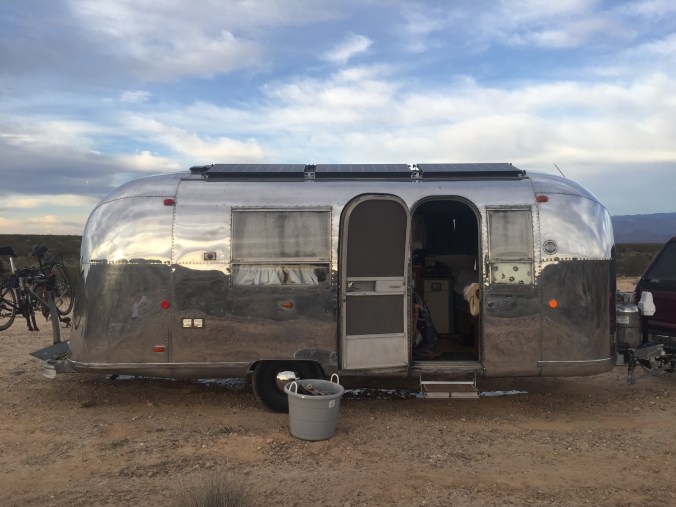
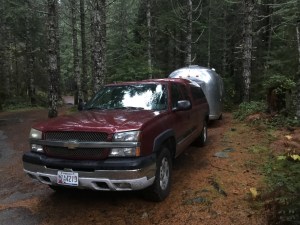
Airstream tucked in at Gilbert Ray Campground, near the Tuscan Mountain District (western) part of Saguaro National Park.

We were both quite taken with this desert, this National Park. All credit goes to Bob, a retired scientist (spent most of his career at the nearby and highly regarded Arizona Sonora Desert Museum) who now volunteers as guide on nature walks in the park.

You know how some ranger talks are better than others? It felt like Bob gave us the keys to the desert – slowly, carefully teaching us about the various plants, one at a time. He explained how they worked together, and how by looking closely, they’d reveal even more about their desert existence, and help you make sense of the place.

img_4672

Our hero: Bob. In his hiking pack, he carries, among other things, a comb, in case he or a visitor gets stuck by a jumping cholla (choy-a) cactus ball. Also, a camera, because as long as he’s been out in the desert, there are still some things he hasn’t seen (e.g. certain kind of scorpions) and would like to.

Though the natural focus of the park is the saguaro (pronounced sa – WAH – ro), the iconic Arizona cactus, most often depicted with a few arms lofted to the sky, Bob taught us about other cactus: cholla (teddybear, jumping and staghorn), prickly pear, fish hook barrel. And their non cacti friends: palo verde, ocotillo, mistletoe, ironwood, mesquite, sage.

img_4658

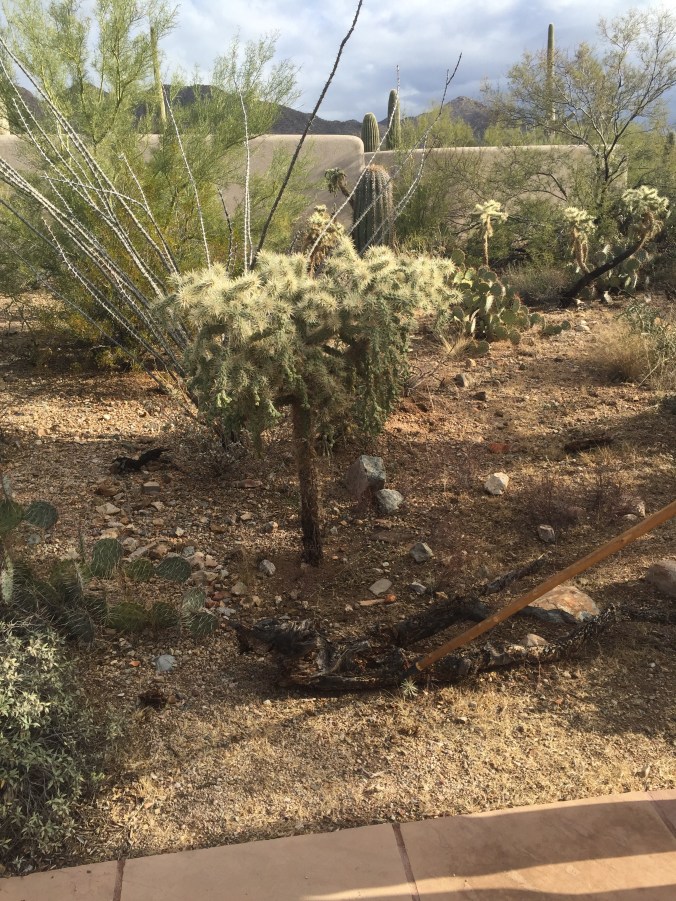
In this picture, one can see palo verde, saguaro, cholla, and prickly pear. Probably a lot more.

Hover/click on the pictures below for a bit more about each…

img_4686

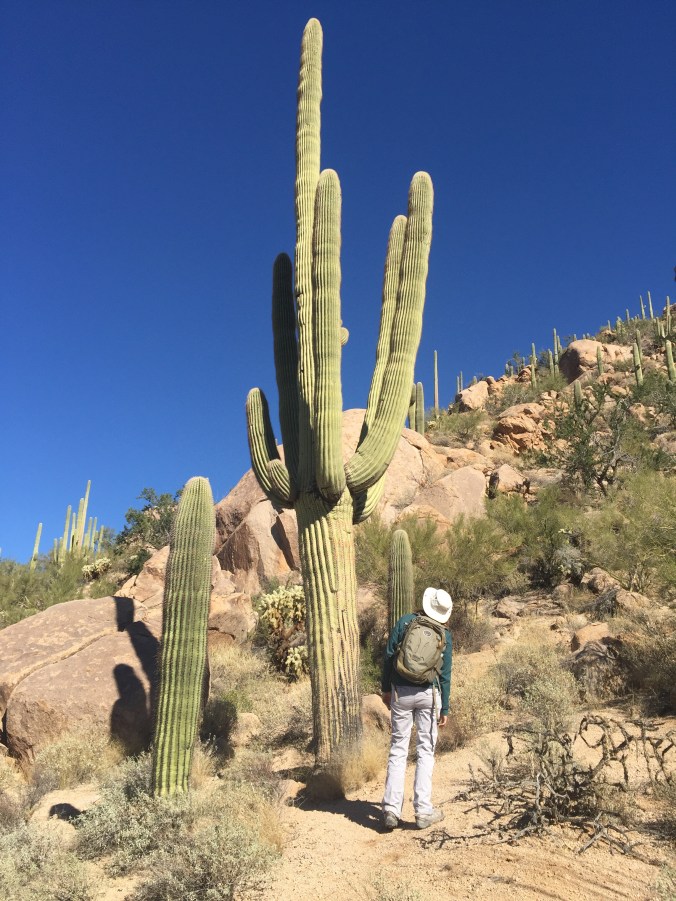
After getting schooled by Bob, we were able to go out and find our own saguaro cacti. On the left, is a younger saguaro, maybe about my age. 🙂 The one I’m gazing up at could be 200 years old.

img_4694

Ben atop the Hugh Norris Trail, saguaro on his left, ocotillo (which look like a fountain) on the right

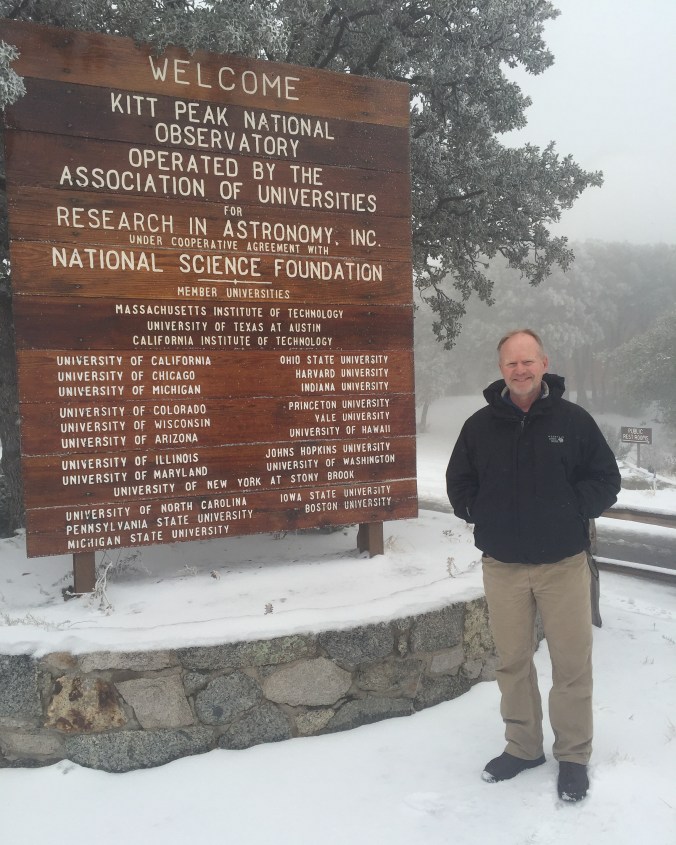
We wanted to check out nearby Kitt Peak National Observatory. It was a bit snowy (Arizona?) so we weren’t able to see any of the telescopes (the paths to them were treacherous), but kicked around the visitors center and had a nice chat with an astronomer visiting from University of Indiana about his work. We would definitely recommend a visit, and a check on the weather at 7,000 feet before you go.  img_4678

We scratched our astronomy itch instead at a program that the folks at Kitt Peak sponsored, but held in the parking lot of the visitors center back at Saguaro: a night-time Binoculars Stargazing program. Ben and I ended up being the only attendees, so we got a lesson on how to use a star map, tips on using our binoculars effectively, and a personal tour of the night skies. Our guide also gave us resource recommendations for future exploration: download the (free)  monthly star guide from SkyMaps.com for a map showing where the starts will be. He also recommended a book for newbie skygazers, young and old: The Monthly Sky Guide, which Santa brought to Ben for Christmas.

Some highlights of what we learned (hopefully translating it correctly):

-There are only 88 constellations in the sky – and they are entirely human creations.
-The North Star – what we know as Polaris – changes. It’s not always Polaris. It’s whatever (bright) star is closest to being directly overhead if you are standing on the earth’s north pole. But Polaris’s position relative to the North Pole is slowly drifting, so eventually (500 years or so) Polaris will no longer serve that role.
-Stars with a blue tint are actually hotter than those with a red tint.
-Ever wonder why your particular astrological sign is in a particular month? Nope, it’s not because you can see your birth month constellation during your birth month. During your birth month, the sun is passing through your constellation, so you can’t see it in the night sky.

We spent a little time in the town of Tucson for some R&R and to do errands. Some of the locals shared that Tuscon is well ahead of other cities -Phoenix, for example – when it comes to things like planning for drought and eliminating light pollution (light pollution is a big deal – affects astronomers, of course, but also animals that require dark skies for hunting, etc.) Tucson is home of the University of

img_4679Arizona, and Cactus League Spring Training. We saw the excellent movie Spotlight, and had Korean food at Kimchi Time where I had the very odd but kind of cool experience of having one of the waitresses walk right up to me and say “You look just like my mom! You even dress like her!” Now, as a non-mom, this was a little strange to hear, and most of my friends’ kids aren’t quite as old as this young woman, so that was a little disconcerting. (Plus, what about the “you dress like her” comment?)  But she was so sweet, we took pictures together, found some more things in common and are now following each other on IG.

On another personal note, we spent a lot of our time in this spot worrying about one of our kitties, who had/has a health scare, but seems to be doing ok now in the hands of his loving DC family: Laura, Mark, Logan and Finn. But do keep the very handsome orange kitty Gordo in your T’s and P’s.

Hiking Angel’s Landing: No Fooling, it was Scary

From Joshua Tree, we motored east to Zion pretty quickly,


spending one night (awesome boondocking) in Nevada, and gathering supplies in St. George, Utah (loved Harmon’s for groceries). Cold weather would be coming later in the week and we wanted to enjoy Zion before it hit.

At the Zion entrance, the rangers promptly hopped out to measure the width of our Airstream, to see if we qualified for an “unescorted” trip through the narrow tunnel to Bryce Canyon. (At 91 inches, we just made the cut off of 94 inches!)

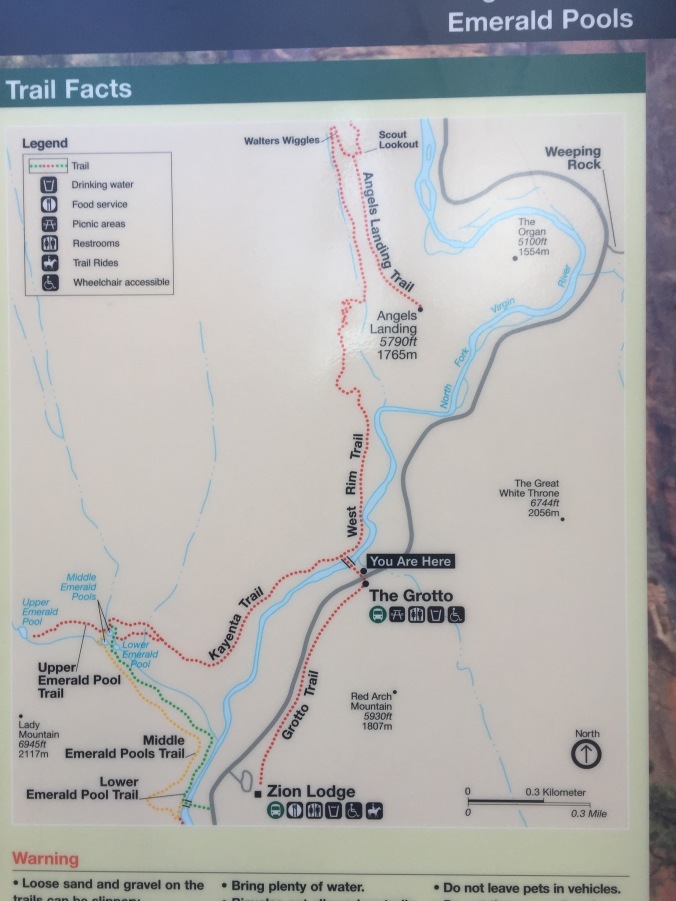
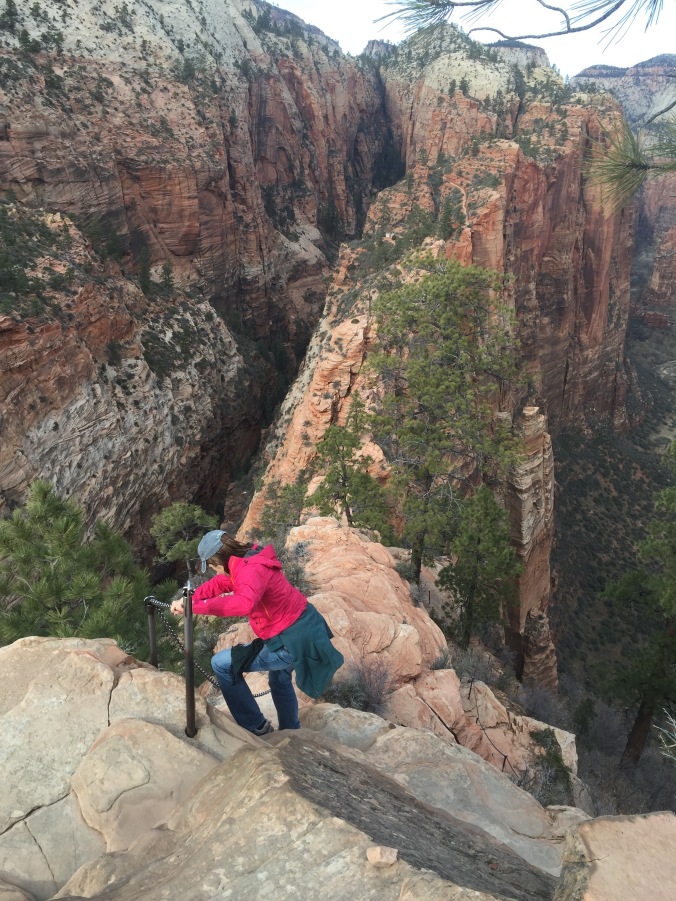
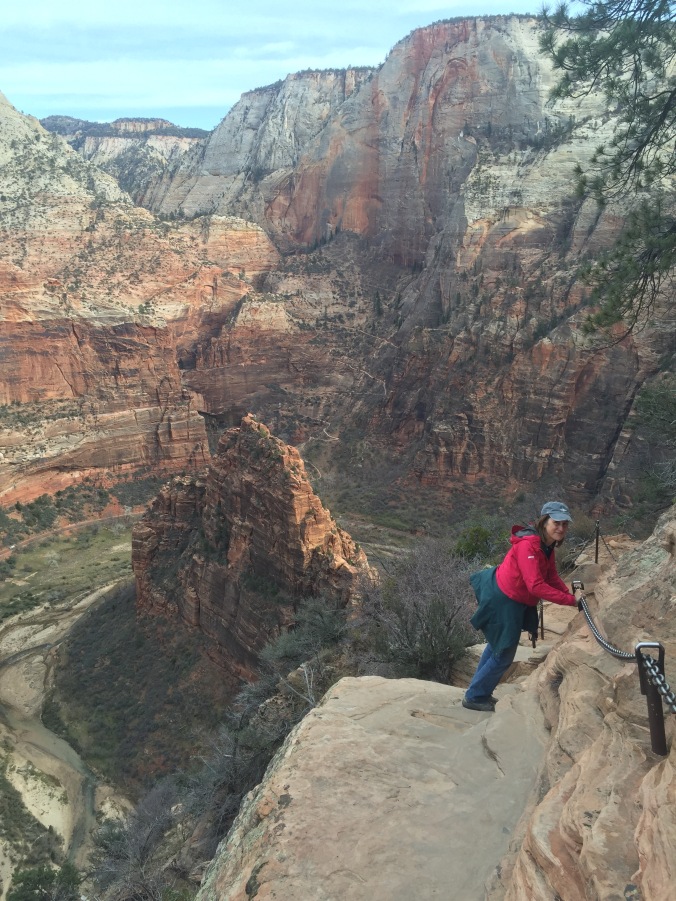
Perusing the information about hikes, we set our sights on Angel’s Landing – a difficult hike but lauded as one of THE very best day hikes in all the southwest. Why? It starts with the West Rim Trail, about 2 miles up a steep hill, then the special part: the  Angel’s Landing Trail, a 1/2 mile hike across a narrow rock ridge – also called a fin – with steep drop offs on either side. Chains are installed to aid hikers along the narrowest and steepest parts of the trail. No one has died on it in the last five years or so. Who wouldn’t want to hike this?

img_4356

IMG_4358

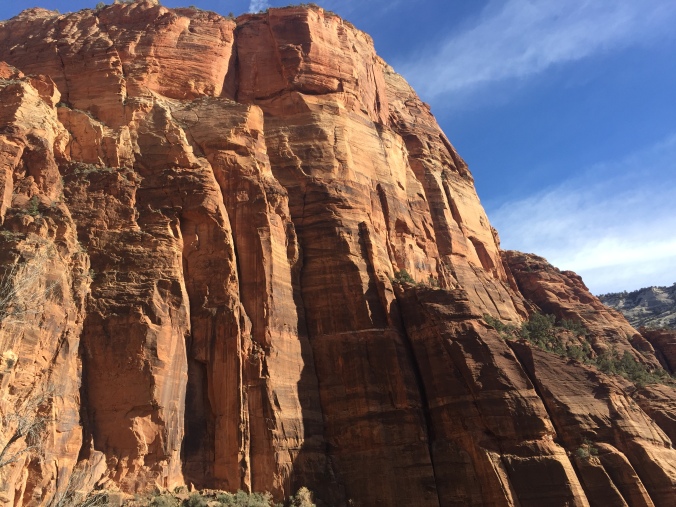
Angel’s Landing from below

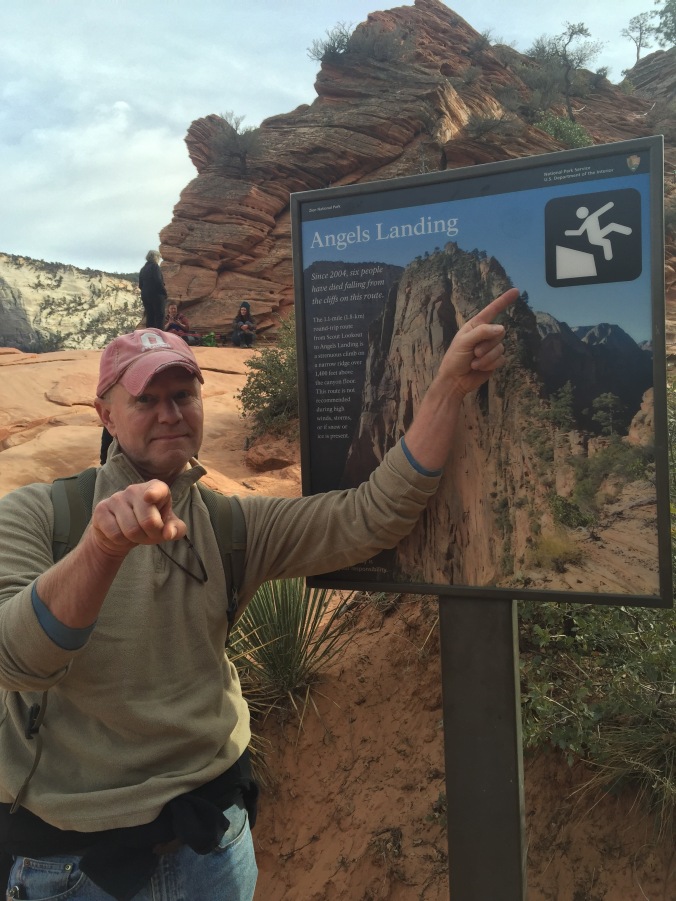
I paid careful attention to the warnings provided by the Park Service and even searched the internet for others. How could a hike that was so perilous also be so popular?  Some warnings stuck with me – from the Salt Lake Tribune for example: if you can’t get your footing without the chains, you might not want to hike it. There have been a half dozen or so deaths in the past decade, and the Park Service does not hide that fact, but rather uses it to discourage people. But A LOT of people do this hike. We figured we could too.

img_4457-1

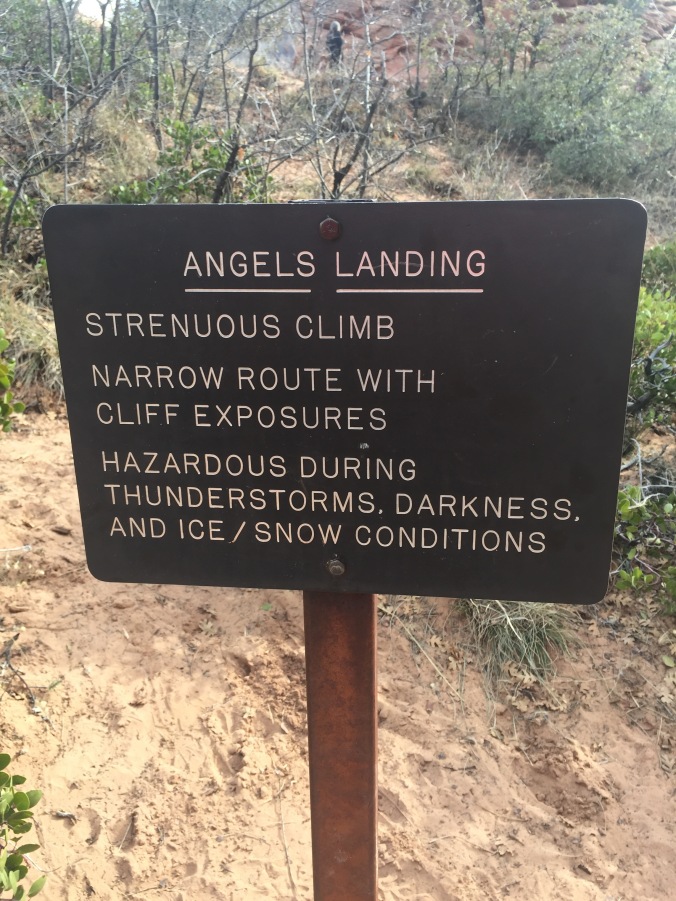
One of the signs the Park Service has posted – very well written I think!

The initial climb up West Rim Trail took us about two hours, just as predicted. We stopped to rest a bit along the way. Though it was December, the conditions were perfect – sunny, no moisture on the trail at all. We maybe saw 10 or so other people going up or down, and 1/2 dozen Park maintenance crew members shoring up the trail at its edges.

IMG_4365

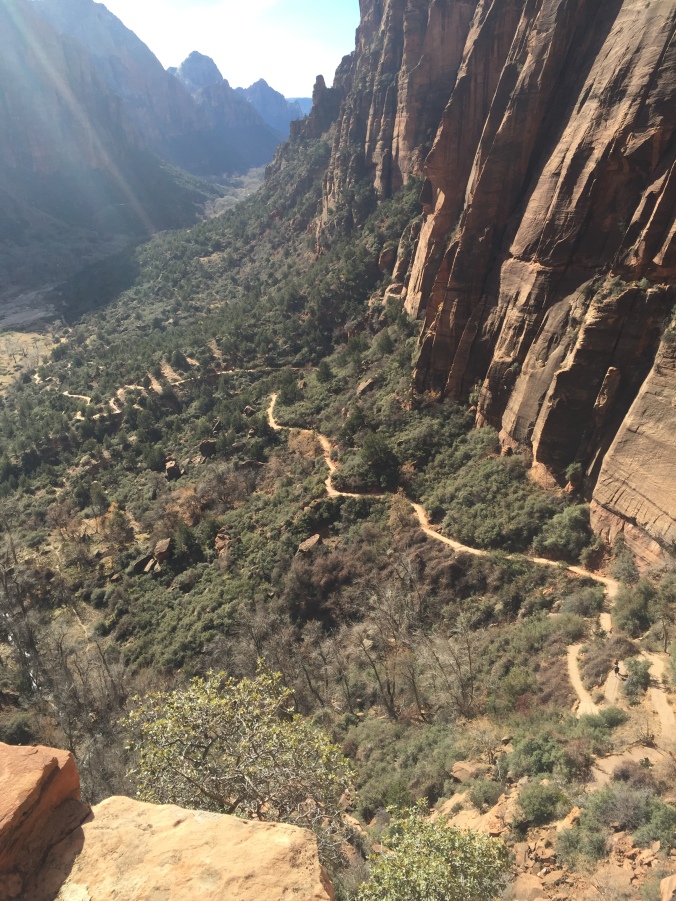
Looking back down after we’d ascended the West Rim Trail,  but before beginning the scary last half-mile.

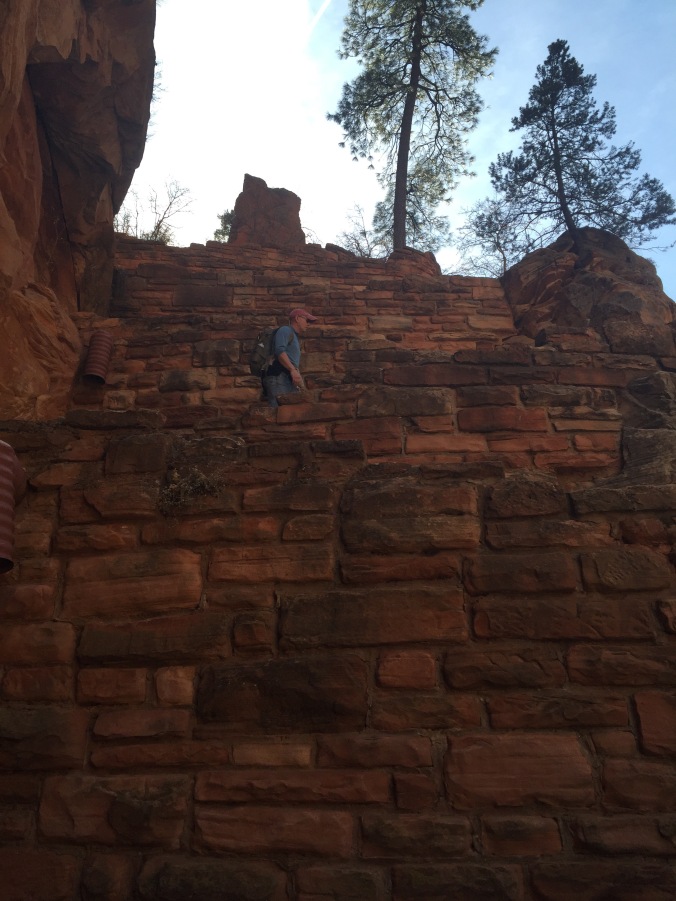
This first section of the hike ends with “Walters Wiggles” (better pic here), a set of 21 switch backs to take you up a very steep part of the trail before the most daunting stretch begins. Apparently they are named for the first superintendent of Zion who designed them!

img_4378

Ben ascending the Wiggles.

img_4377

The Wiggles from above.

Now, I have to say, at the top of the mountain, at a place called Scout’s Landing, and before we began that last 1/2 mile stretch onto the actual Angel’s Landing Trail, I had a serious talk with myself about whether or not I was really going through with this. Some of the things I said:
“A lot of folks decide not to continue here. There is no shame in that.”
“It’s going to be tough, physically, but mostly mentally, and I have no problem getting down on my hands and knees if necessary to get across.”
“I am doing this mostly for the ‘I’ll be glad when I have done it’ feeling. I love that feeling.”
“This will be thrilling, and I’ll be totally ‘in the moment’ while doing it.”
“Holy smokes.”
“How often do we get these chances in life? Let’s go!”

The first section builds confidence – it’s steep and narrow in places, but without the sheer drop off inches away. Fairly soon though, I arrived at a critical juncture when I saw what looked like a very, very, narrow tightrope-size ledge strung between the rock outcropping I was on and the one I wanted to get to. It scared me. I felt physically woozy in my gut. How was I to go over that, knowing I’d only have to go over it again on the return? And, to add to my fears, I couldn’t see or plan for what to expect on the rest of the Angel’s Landing trail ahead, so I couldn’t know if I was expending the appropriate amount of courage at this juncture, or if I should save some because I’d need even more along the way. A true dilemma, with not a little pride at stake.

About this time, an older couple appeared, descending the trail and coming toward me – clearly reading my mind. They offered, more off-hand than directly to me – “Oh it’s easier coming down than going up” and “You’ll be glad you did it”. Somehow their words helped, and I am not ashamed to say so did the fact that they were older (most of the other hikers we’d seen were millennials practically running up and down the mountain in toe shoes.) I forged ahead.

img_4386

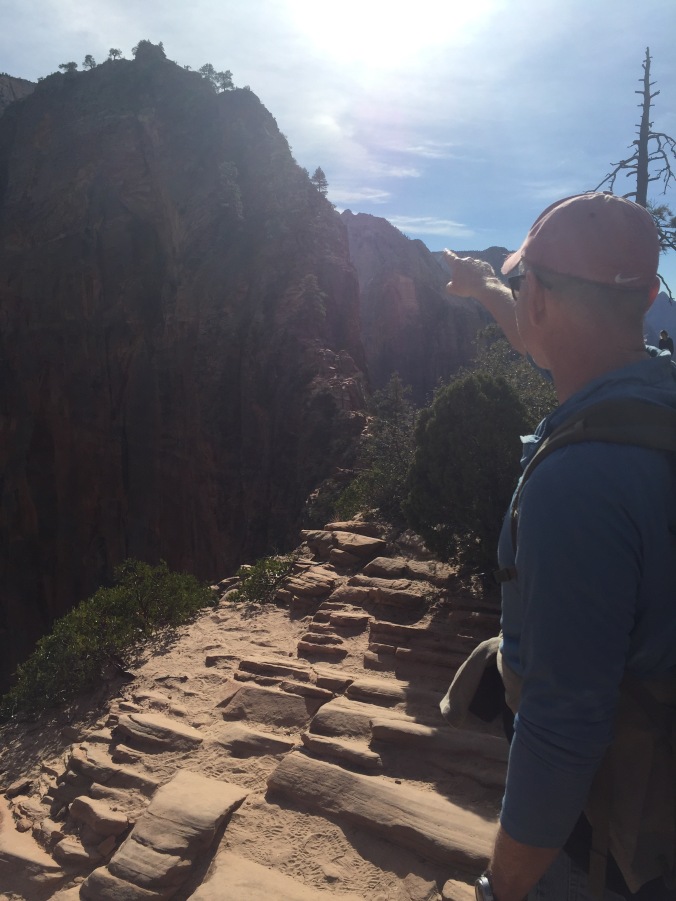
This isn’t the site of my point of no return ruminations, but it looks a lot like it. Ben is pointing toward the trail.

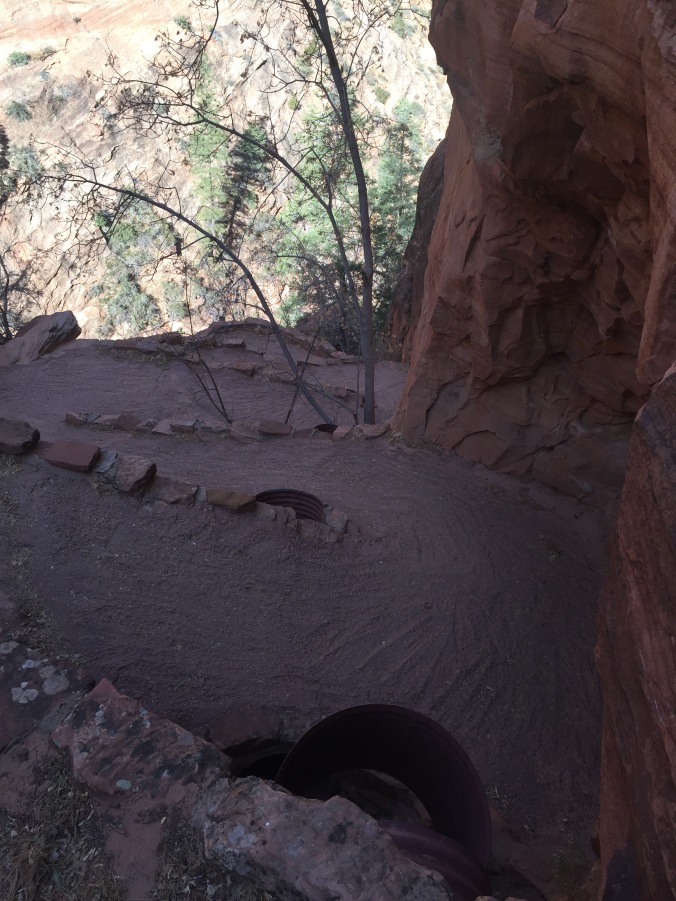
Each 100 feet or so is a different challenge – pulling your self up, along side, against [insert preposition here] a rock face, with sure death in the form of a 1,000+ foot drop just inches or less away. It’s not hard to imagine how you could fall – it was more a matter of when.

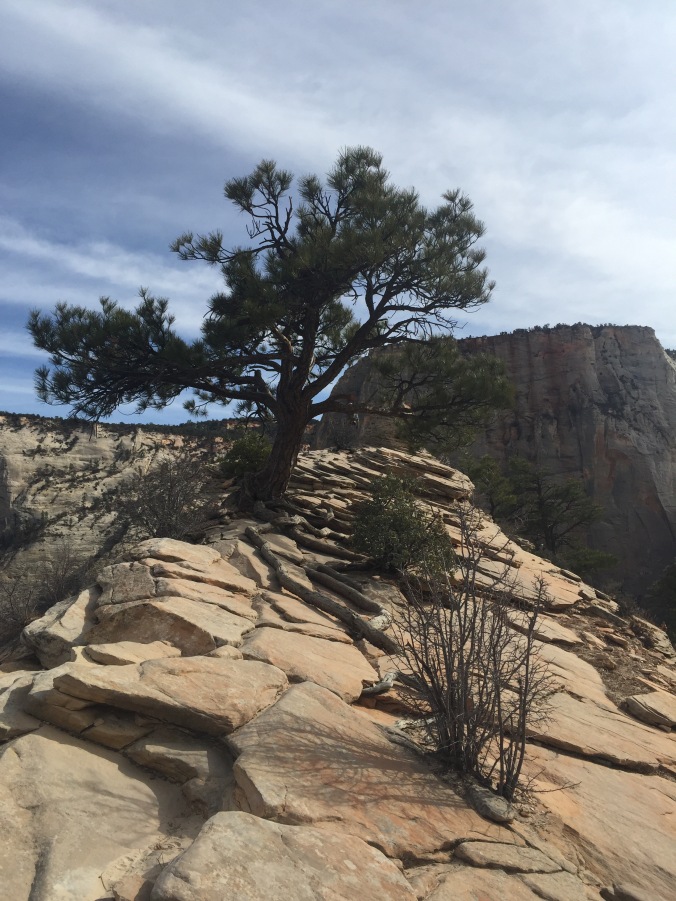
We were lucky there weren’t more people around – in the summer the path is crowded, and all those people make the trail more perilous. For example, when two or more are holding (and  moving) the same stretch of chain, or one is going up while another is going down. (When in doubt on a narrow rock face , go for the hug). Success is found in hopefully a shared belief in the preciousness of life, and a collective fervent but tenuous grasp on it while together on Angel’s Landing. (For the most part people were very well behaved, though we did pass a couple in some kind of argument – lips pursed, eyes stony, heavy sighing, the whole nine, somewhere midway-ish near the tree pictured below.img_4390

img_4387

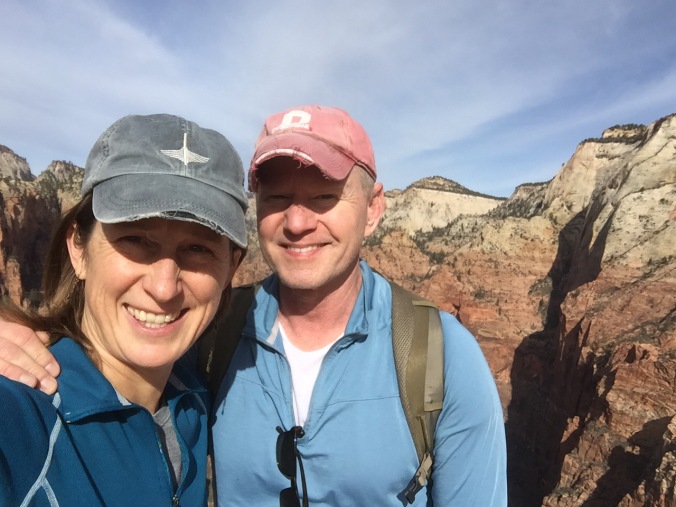
Triumphant selfie, reunited about about midway. Mostly Ben hiked ahead of me and I took it nice and slow.

At another more treacherous point somewhere in the middle, I did gather myself a bit to at least appreciate the fact that while I was “in the moment”, I wasn’t appreciating the views. But the trail was so narrow here, I didn’t dare turn my head, and risk losing balance. So I literally raised my right and left arms just high and quick enough to take a shot of whatever it was I was missing, so I (and you) could see it later.

Finally we reached the end, a fairly wide rocky plateau with plenty of places to sit and rest and relax and eat lunch, reflecting on accomplishment, scouting for angels. We saw one reincarnated as a chipmunk who persistently hovered trying to catch our crumbs.

Indeed the trail back was easier, but maybe only because we knew what to expect. As you can see in the pics below, those chains were put to good use by me and my bad knees.

img_4437-1

img_4443

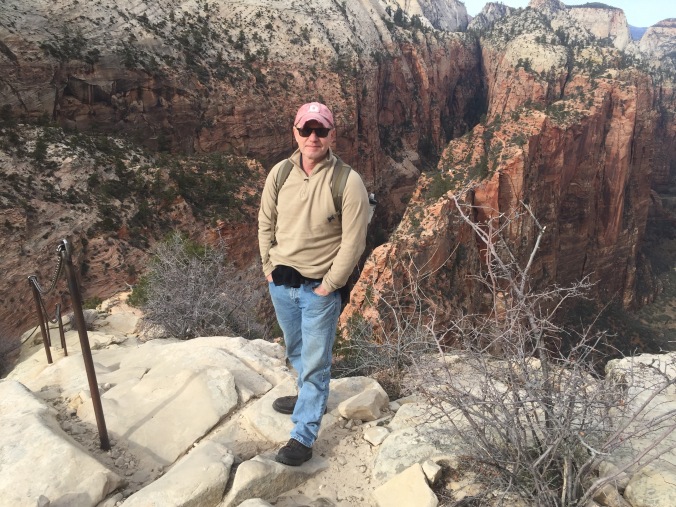
For Ben the way down, like the way up, was more of a walk in a park. Hands in pockets, shades drawn. Movie star cool.

img_4413

Of course we made it. I had conquered the fears that had cropped up, it had been thrilling, and I was glad to say I had done it. Though Ben thought this image of a hiker tumbling looked awfully similar to how I had deliberately approached the descent.

img_4454
And finally, nothing says “I defied death and conquered my fears” better than having happy hour outside on the “patio” in December. This one included our very first (in four months on the road) campfire. Cold, but very much in our comfort zone.

img_4498-1

Loved our spot in Zion’s Watchman Campground

Joshua Trees and Rocks

We arrived in Joshua Tree squeaky clean – after spending Thanksgiving at home in Glendale, where we took the time to make a few tweaks, tackle some fixes and a conduct a general “clean up” (of us and the rig). The drive to Joshua Tree was a little over two hours and if you are coming from LA, either the West or North entrances will do. Joshua Tree is small enough (relative to some other NPs) that it’s worth trying drive through and hit all its corners as you plan your itinerary.

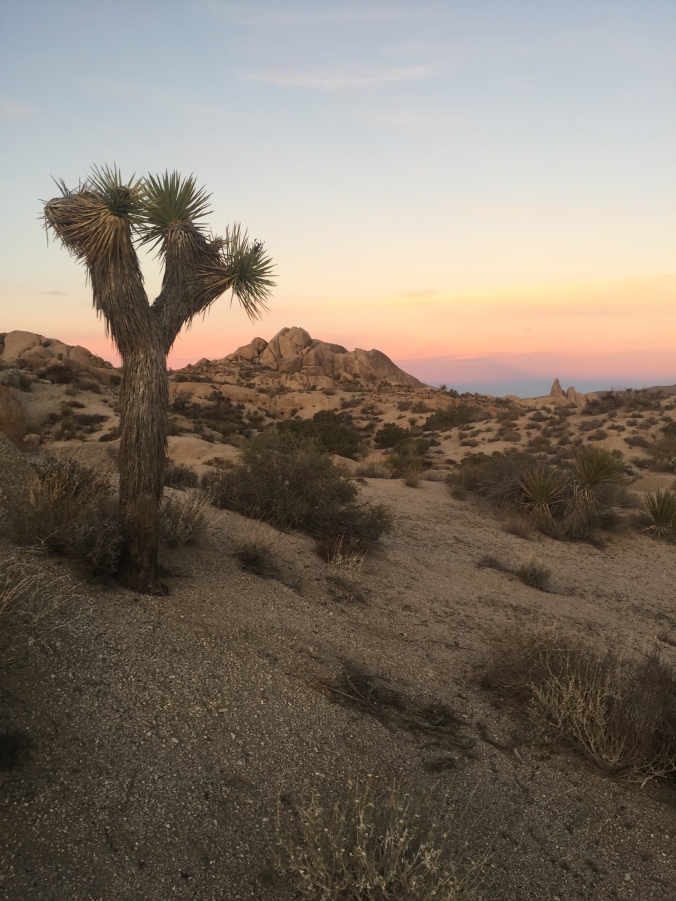
We believe we found the best site ever in Jumbo Rocks campground: #77. With an unobstructed vista of rocks and sand and desert scrub, and of course Joshua Trees.

Many of the sites there are tent-sized only, which leads to a good mix of tent campers and RVs (alas they do allow generators here at fixed times). As the sun was setting we took a walk.

IMG_4084IMG_4089

Ben and I passed the camera back and forth seeing who could take the best pictures. They are all winners, don’t you think?

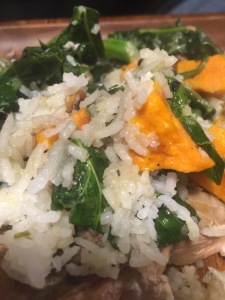
Dinner was all the food I had bought intending to cook while at my parents, but didn’t. You see, if I left it there, my parents wouldn’t eat it. You know? Salmon, collards, rice and sweet potatoes.

IMG_4106

Mostly from Trader Joe’s, which, if I had to choose only one place to shop for Airstream cooking, would be the winner. Thank you mom and dad for stocking our fridge.

We watched the Caine Mutiny b/c some scenes were filmed in Yosemite. (Make no mistake, there is no cell service in JT, but we had downloaded it at my parents’ over the weekend.) It was a brief (and corny) scene but otherwise good movie. Got us thinking that would be a fun theme to follow – other movies filmed in National Parks. Any recommendations?

We woke to another sunny temperate day in California – but the first we’d had camping in several weeks! There is really nothing better. Here I am IMG_4108breakfasting outdoors – something we haven’t done in a while. Our breakfasts can get pretty routine, but I love them all: it’s either cereal, oatmeal or eggs. This must have been a cereal or oatmeal day. The only downside is Ben and I have to eat the same thing – due to just wanting to avoid two people in the kitchen, extra dishes, etc. Oh, what we give up to go on a once in a lifetime cross country trip!

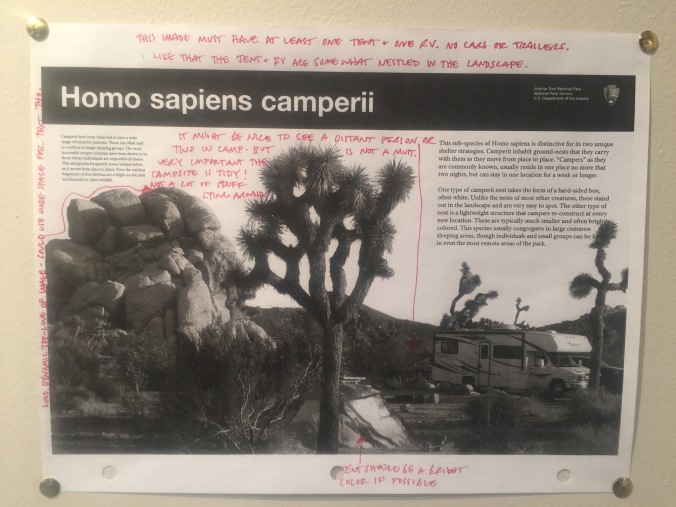
We bopped over from the east side of the park to the West Entrance Station visitor’s center, which was small but staffed with super helpful rangers. They also had one of the coolest exhibits I have ever scene – a look inside the creative process behind the design of park PSAs. The PSAs were meant to promote appropriate park behavior to various types of visitors – the ad below is a mock up of the one aimed at campers. The “behind the scenes” revealed the editors wanted to be sure to pick a picture that included a tent and an rv/trailer. I don’t know how well this translates, but the English teacher in me just loved it and hats off to the staff for sharing it. Compare the draft up top (with editor’s notes) to the more final version below it.IMG_4114

IMG_4115After consulting with a ranger, we set a course to do several short hikes as we crossed the park from the West Entrance, past our campground, toward the south entrance. If fact, you may want to start calling us “Short Hike Barkers on Break,” we did so many. Feel free to follow along (from left to right) on the map below.

JT map

First up, Hidden Valley. As the name suggests this expanse is hidden behind a ring of boulders. Rumor has it (not much confirmed historical fact in the stories here, but they are upfront about it!) cattle rustlers used to hide out here with their loot.

IMG_4123

Can you spot Ben hiding in the valley?

You will see boulders and Joshua Trees, and other trees and all kinds of shrubs and bushes (technical terms anyone?). The walk here, as throughout most of the park, is on sand, like being on a beach. You will see climbers. More of Hidden Valley below…

It was a clear day for the next stop, a drive up Keys View. You can see Palm Springs and  the whole Coachella Valley, and the Sultan Sea. Mexico too, they say, but hard to tell. Somewhere down there the San Andreas fault is biding its time. We ate our lunch on a bench overlooking the view.

IMG_4156

The view from the aptly named, Keys View

Moving east, we hadn’t really planned on stopping at Ryan Ranch, but the adobe remains can be seen from the road and called to us. Much graffiti and ranch “trash.” Climbers too. Enjoy my artsy pics.IMG_4167

IMG_4160

Next stop the Ryan Mountain trail head , not to hike the mountain (a “challenging” hike) but to see Indian Cave – not much of a trail but a cool IMG_4174rock that has campfire smoke from who knows how many eons of campfires.

We met Hash the van-cat there as well. He remindeIMG_4170d us of one of our cats, Gordo (who’s orange too).

When we told them about Gordo, Hash’s owners said: “Gordo! That’s such a great cat name!”

They were super hip, so we felt hip too. Not so hip to live with a cat in van though. Don’t worry, the windows were cracked and the temps mild. Shortly after this pic, he headed into the back for a nap while his owners hiked.

Moving east, Live Oak picnic site doesn’t advertise it-but if you drive a bit beyond the picnic tables on the dirt road you can see the growing, healthy live oak (below) for which the site is named. We hiked beyond it on a pseudo-trail and really enjoyed the views and the solitude and the ROCKS. If these pictures don’t convince you to sign our petition to rename this park “Joshua Trees and Rocks” then you are missing the big picture.

IMG_4175-0

Finally, timed for sunset, a bit toward the South Entrance, we visited the Cholla Cactus Garden. You can really see the terrain change on this drive. It’s not gradual. It’s abrupt. And the cacti literally glowed in the sunset while the views of now the Colorado (as opposed to the Mojave) desert mountains were lovely.

The next day we had a lazy-ish morning – Ben hiked around and I did yoga in the sand outside the trailer. I’ve done this a few times now – yoga outside is the bomb; yoga to combat aging muscles that spend a lot of time in the car is the bomb de bomb. From our campground, we hiked to Skull Rock – a popular spot, and sure enough someone offered to take our picture. See how relaxed I am from yoga? You’ll note I am holding my newly re-acquired fanny pack, which, unlike all my jacket pockets, is indeed big enough to hold my phone. It’s getting deployed a lot now.

IMG_4207

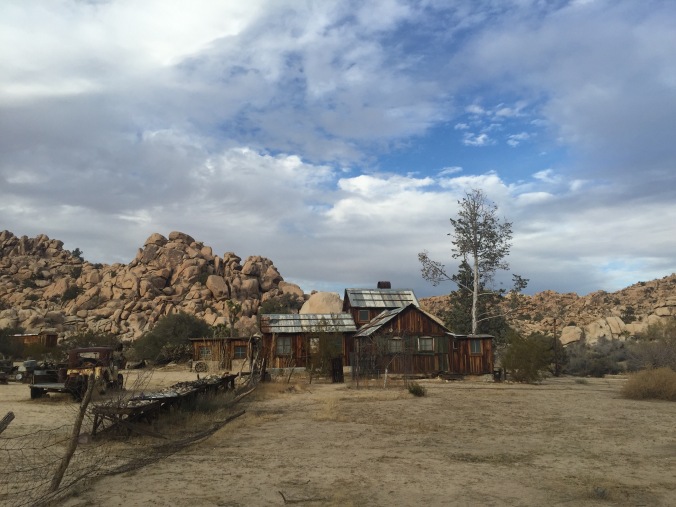
We had signed up for the afternoon tour of the Keys Ranch. The Ranch sory was interesting enough, but I found the site just very visually striking – these dark strokes of lumber and piping and machines against the Joshua Tree browns and sands and blue sky etc.

IMG_4232

And though any kind of private tour seems at odds with the concept of a National Park, it did feel special to be there, and as though the Keys family had just up and left in a hurry, and here we were sneaking a peek. No neat and tidy site is this – it’s the sort of place they’d love to find on American Pickers. Junk everywhere. And the life story of the Keys family isn’t tidy either – for example when asked what Mr. Keys’ profession was, the guide replied “A little bit of everything” which is what it took to survive in the desert. Mr. Keys – actually ended up serving a IMG_4230sentence in Alcatraz – I won’t spoil it by saying what it was for (think Wild West).  The oldest Keys son visited the site regularly until he died just this year. He will be interred at the family plot still on site. The tour cost 10 dollars, and is only offered three days a week, though they are popular enough that they will be adding some more. I imagine it’s a struggle for the hardworking public servants at NPS to have to limit access to such a cool part of the park.

IMG_4231

The rangers have access to a Library/Archives onsite to help them research and show “past and present” like with this old photo of an area of the ranch.

Afterward, we had time for one final short hike – Barker Dam of course. It hadn’t been heralded in any of the hike guides we perused, but of course we had to go. And it was fantastic! Again, maybe b/c of the time of day. It was flat, with rolling hills and the most incredible site in the middle – a dam that was built and rebuilt by ranchers who lived and grew live things here in the desert!

More pictures from Barker Dam….

Joshua Tree was a great way to launch our time in the southwest. And, though doing a bunch of small hikes and seeing more doesn’t always feel like the right approach, it worked very well for us at this park.  Like the Joshua Tree itself, we avoided establishing deep roots in any one part of the park, and instead attempted to absorb as much as possible through a broader approach.


Holiday Refit: 10 Airstream Fixes

After 11 weeks on the road, we pulled into my parents’ SoCal driveway with a medium size list of things to fix, tweak, switch out or alter. Here is the list, the first few in order of importance/annoyance; the rest are a bit “in the weeds” but we include in case those undergoing a restoration can learn from our experience!

1.Trailer brake lights. In Oregon, we had a “sudden stop behind a semi on the highway don’t know if we are gonna make it” scare, which made us think hard about how well the folks behind us could see our brake lights, especially obscured by the bikes. Ben wanted lights that would somehow blend in and found these bright LEDs to attach to the Airstream bumper. He spent a good amount of time making sure the install was clean, and of course, functional!IMG_4296

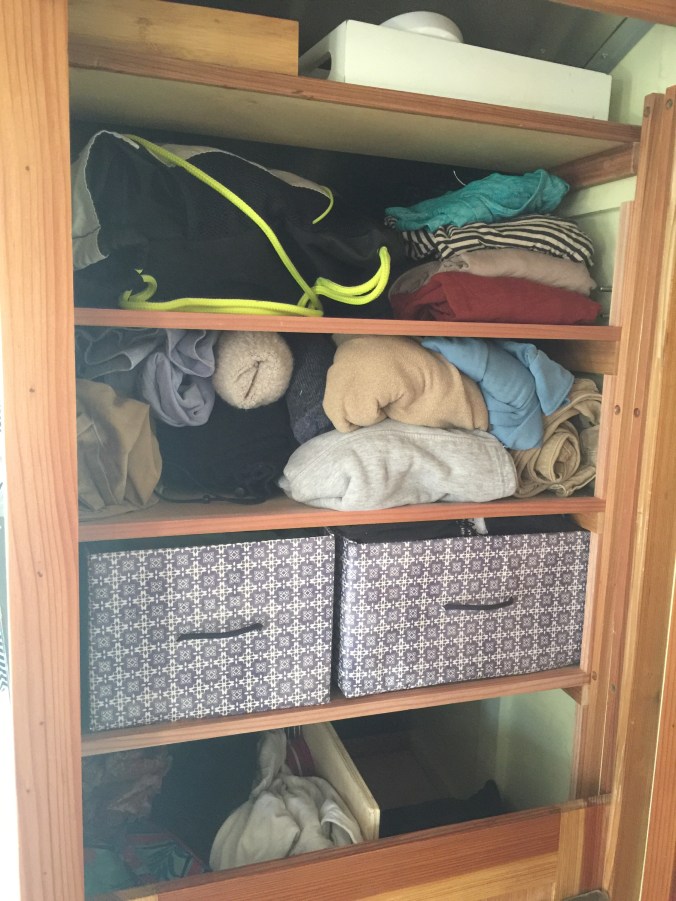
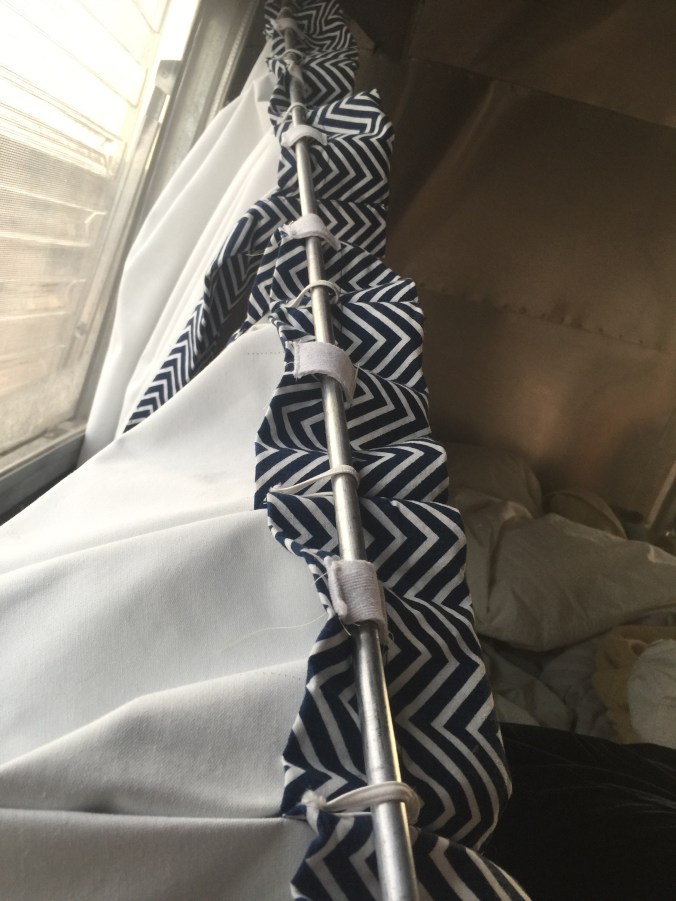
2. Closet renovation. At first we had a small closet with a hanging rod and one of those hanging sweater things. The “sweaters” always fell out, and of course we just don’t have a lot of clothes to hang. We do have clothes to roll up, stuff, and most importantly to store in a sort of purgatory when we are planning to wear them the next day. Hence the new closet with shelves only. We’ll get it a bit more organized, but as a quick fix I made a couple of “drawers” out of cardboard boxes, covered them with contact paper and made rope handles. It’s working out great! The purgatory “bins” are the bottom row – Ben added that wood divider at the last minute so we’d each have our own side. Good idea. IMG_4058-03. Curtain tabs instead of metal hooks. I made the curtains and I guess to save a little time/labor I attached them to the rods with metal hooks. Boy were those a pain. They were hard to open, close, the hooks were always coming off and when we drove, the rods would often fall off. I retrofitted them by sewing on tabs (much harder to do on a machine after the fact) and they are working like a dream now.

IMG_4318

4. Woodwork – a few things that a little woodworking helped to make better. Clockwise from left: a “dam” to block errant water flow in the shower (the eucalyptus is new too!); Ben fitting and making fiddle rails for the dinette/bed cushions; and a little platform to raise our pantry cabinet so the door opens / closes more smoothly – it had dragged a bit on the floor before.

5. A little metal work – hanging, bolting, etc. which really all come down to creating more/better storage. Left to right: Some new hooks in the shower to hang our dirty laundry bags. Also in the bathroom – Ikea had these nifty metal shelves and one is up now to hold my main toiletries bag to make more room on the counter top. Finally, we already had the bread box, but now it’s bolted down!

6. Trailer hitch The paint on the weight distribution bars had been coming off and there was some surface rust. Ben scraped the old paint off, sanded and repainted with  POR 15. It’s a Reese hitch system which we are loving overall, but we were surprised the paint deteriorated so quickly.

IMG_4294

7. Bucket We swapped our “Pacific blue” bucket (in which we keep chocks, stabilizers, etc) for a new gray one (from Target). For many (snobs) in the wooden boat community (from which Ben hails), Pacific blue is an obnoxious, thoughtless, in your face color for boat accessories. It did NOT blend in with the Airstream, especially in pics. Ben hated it. (Can you tell?)

IMG_4307

8. Polish And finally – in my mind we were only going to do it if we had time – in Ben’s it was gonna get done no matter what: a quick and dirty polish using S-grade Nuvite polish and the cyclo polisher. The truck got a nice washing as well. IMG_3991

9. Jettisoning some stuff So, our truck bed was crammed full, and we did some hard sorting and left behind stuff we hadn’t used and came to realize we likely wouldn’t miss: a foldable kayak and accessories, a metal detector, sewing machine, exercise bands (kept the yoga mat), some clothes (see pile below; but added my slippers, which I had foolishly thought I wouldn’t want), our tent (kept the sleeping bags).IMG_3987

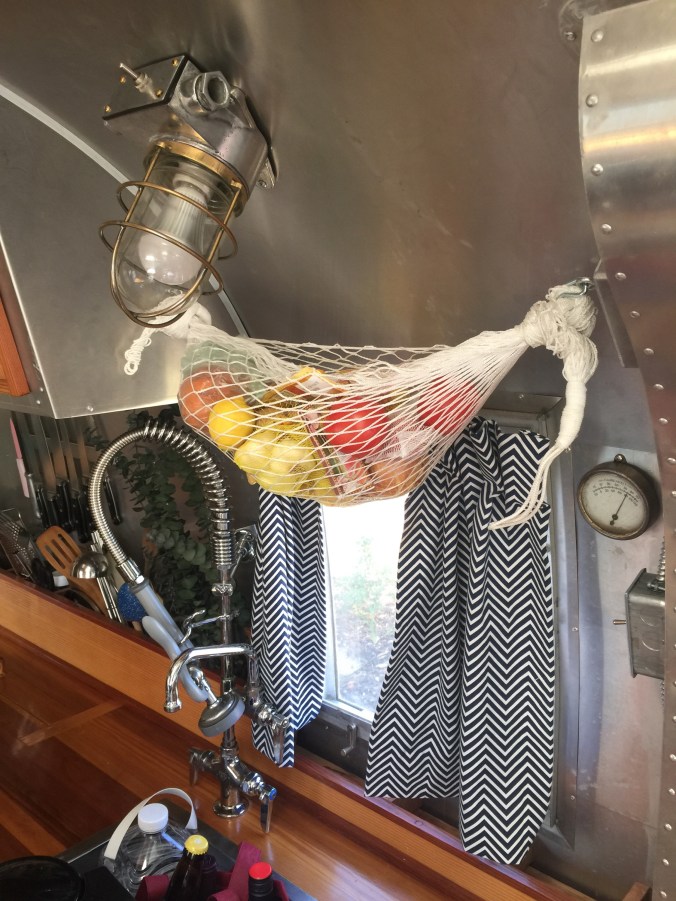
10. Storage Hammock Where to store produce that doesn’t need to be refrigerated? We had tried everything and we bought and installed this gear hammock (from a marine store of course). It was hard to pick a practical spot that wouldn’t stick out too much – we settled for above the sink. IMG_4056-0

So, off we go, 2nd leg, Southwest here we come, on our way to Ben’s family in Dallas for Christmas, with hopefully a shorter refit list so we can enjoy family and put the rest of our time and energy into rooting for the Sooners (Ben’s alma mater) in the playoffs!

IMG_4064

Yosemite: Two Pieces of Advice

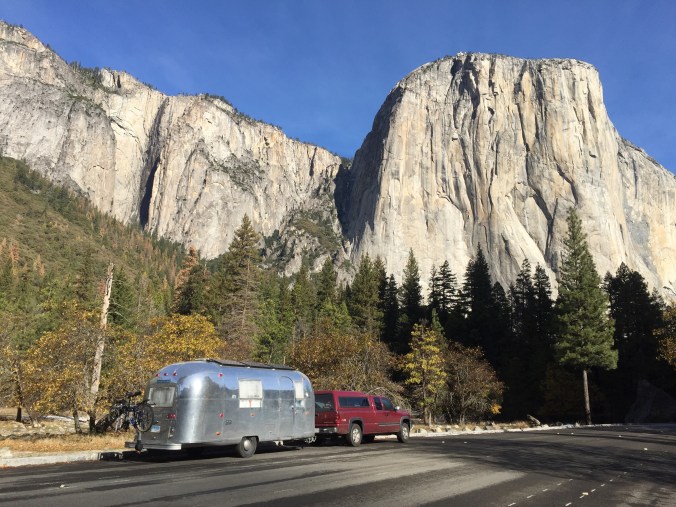
We got two very good pieces of advice before heading to Yosemite, both from friends who we had visited in the Bay Area the previous weekend. One piece of advice was more practical, the other more, shall we say, spiritual. The were both key to to a great, great visit to this gorgeous National Park.

IMG_3889

Spoiler alert: Yosemite is A-MAZING!

The first piece of advice was about winter access. Yosemite is in the Sierras. It snows there. If it snows, the park will be open, but you might not be able to get there with your Airstream trailer unless you have chains for your tires. They are very strict, gentle but firm about this. It is in fact the law. You can buy chains (which we didn’t want to do) or you can hope the warming trend coinciding with your itinerary will yield an upgrade of road conditions, allowing you to enter the park without chains. How will you know if the road conditions change? Call this number: 209-372-0200.FullSizeRender (3)

Some talented park ranger has to do a new recording every time road conditions change  – on the first night of our campground reservations (a Tuesday), the conditions were still “R3” closed to neophytes like us, people driving cars without chains.

So, like the pioneers when they faced similar challenges, we bided our time at a lovely winery. This Harvest Host, Vista Ranch & Cellars in Merced was perfectly situated just a few hours west of the park. In fact Merced was a jumping off point for tourist trips to Yosemite back in the day, and even today, those without a car (or chains) can take a bus from there, or even as far away as the Bay area.

The next day, Wednesday, temperatures were up, that snow was surely melting, and in fact when we called the road conditions line, all had been upgraded to “R2”!  You would only need chains IF you didn’t have four wheel drive (we did) and M + S tires (we did). Even still, when we arrived at the west entrance from 140, the so very helpful and sympathetic NPS staff at the gate (clearly reading off a checklist or some sort of matrix) told us that b/c our trailer had its own set of brakes, we would still need chains. Harrumph.

However, a ranger was quick to help us come up with a plan B: book a night at Indian Flat RV Park, about 8 miles down the road, unhitch and head IMG_3657into the park for the afternoon with just the truck. And, assuming all continued to improve, we’d surely be able to get in with the trailer the next day (Thursday). As with the 99% of other times when Plan A has failed, Plan B turns out to be as good or better. Because look who we got to meet at the Indian Cove RV Park? Tigger, the RV park cat.

We quickly unhitched and headed back to the park – we felt like we had been sprung from prison, FREE, as we rolled by the entrance gate, approved to enter with only our 4 wheel drive and M + S tires. We were free to explore for the few hours of daylight left.

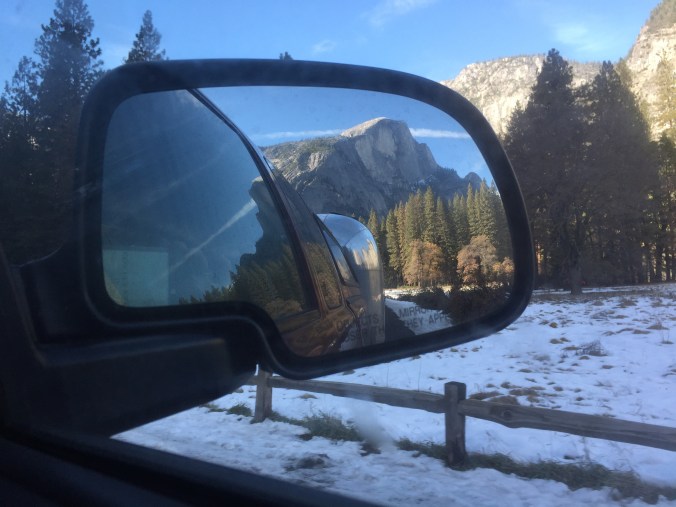
Though I grew up in So Cal, I had never been to Yosemite. I had some sense of what to expect, but was not prepared for the scale of the mountains, their pure granite beauty, and of course the stunning minute by minute changes the rising and setting sun casts on them. Plus there was snow! Melting and slushy mostly, but quite icy in spots too. Happy tourist below – first time in Yosemite.

IMG_3615

Yosemite Valley is more or less a loop road – with free park buses that run a continuous loop to all the major sights and trailheads, so once you are in, you are encouraged to park your car and walk, bike or hop on the bus. Most trailheads, and even the Visitors Center don’t have parking lots. It took us this afternoon to figure this out.

But first, we made our way to the Pines Campgrounds, where our reservations, you may recall, had begun the night before. Despite the prominent signage saying “no refunds”, the ranger there was more than helpful in refunding the night we missed, and moving our reservations forward another day. It never hurts to ask.IMG_3630We stopped in the Visitors Center to do a quick perusal – watched one of the movies and came out to a completely altered night sky. Is this what it’s like every night? Wow.

IMG_3645

Back at Indian Flat RV Park, we rested up and hoped for the best on road conditions the next day. In the morning (Thursday), as we prepared to drop our quarters in the pay phone to find out, Ben ran into one of the rangers who helped us the day before – he came by on his way into work to tell us that indeed, they had changed the conditions yesterday. We were “R1” and good to go. How is that for customer service? Off season camping rocks.
IMG_3662-0

And we are in!

After pulling in to spot 151 in a nearly empty Upper Pines campground, we immediately set out on the Mirror Lake trail. Recommended by more than one ranger as a good “warm up” hike and one that would not be too icy. Nothing like snow to help you track the wildlife!

IMG_3678

Very suspicious. Seen near the dumpster in our campsite.

Note, there appears to be a Mirror Lake photo op, where you can hop off the bus, walk a few hundred yards to the Lake and move on. However the trail is longer, more meandering, a true suspense builder as you go.

IMG_3729-2But wait, here is where the 2nd piece of advice we received kicks in: from my friend Joan’s book shelf, she kindly let me borrow “Yosemite Valley: Secret Places & Magic Moments” by Phil Arnot. In his Introduction, he lays out some general tips for experiencing the park as more than just a tourist. One that we took to heart was to agree not to talk to one another for certain time periods. “Conversation is distracting,” Arnot explains. In order to have an in-depth experience of the Valley, silence and solitude are key. Now, Ben and I have had some really great conversations on some of our longer hikes on the trip so far, and I realized those conversations were in part borne of the time alone, the quiet, the serenity of the natural environment, the meditative quality of one foot in front of the other on the trail. It really did make me realize how much that same environment can encourage similar results, but within yourself. We were both game to try it and the Mirror Lake trail was perfect for it because there was tons to look at, the landscape was slowly but continuously changing.

IMG_3679

This is Ben, practicing non-verbal communication as a part of our pact to hike in silence. He is saying, “Don’t take my picture!”

Most of the first part of the trail was densely wooded alongside a river. Then it opened up into more of an open field (many trees had been toppled) and clear views of those granite mountains. Incredible! Because we had been quiet, I really noticed more. The mix of fall (leaves turning, browns and golds) and winter (icy snow, bare tree) struck me as well. We crossed the river and came back on the other side.


It was about a five mile hike and we were wiped, and it was getting late, toward sunset, and we wanted to squeeze in one more activity. We hopped on the bIMG_3779us and got off at the Yosemite Lodge (for hot chocolate) and walked to the Yosemite Falls foot bridge. It was nearly deserted, and though the iPhone pics don’t do it justice, a lovely way to see the falls.
On the bus again, we got off at our campground stop and the driver called out to make sure we had a flashlight. We did, thanks to Ben thinking ahead but still bumped around a bit among the loops to find our site.

The next day we set out to do a more challenging hike – Vernal Falls. We could walk to the trail head from our site and checked out the Mist Trail on the way- which I understand is packed during high season and was now completely empty. IMG_3696The trail to the Falls was quite icy in spots. We hiked alongside a group of 8th graders and figured if they could do it, so could we! The elevation gains were gradual enough so it wasn’t just a slog, and the views changed incrementally providing something new to look at at every switch back. Again, pictures don’t do it justice. Once we got to the falls, we were up for going a bit further so continued on toward Nevada Falls. IMG_3816We got just to Clark Point and the road closed signs were enough for us to call it quits there. Many other hikers, mostly fellows on their own, hopped the fence and kept going (they had better equipment) but so did a group of three women in their 50s from Korea – one of whom lives near Yosemite now and comes every few weeks to hike.

After hiking down, we explored Curry Village a bit. We saw dozens of people arriving to check in for the weekend. I bought some new sunglasses (I lost mine on the Mirror Lake trail but never noticed it – all that introspection can have its downside) and we found out we could NOT make a last minute dinner reservation at the Ahwahnee for dinner – the super fancy lodge dining option. Probably best as I am not sure what kind of outfit I could have scraped together.

IMG_3636

The dining room was closed for a private event but I snuck in and snapped this picture. I have yet to have a fancy dinner at a park lodge. 😦

We ate at their bar instead – it was nice to get out for the evening, but I would not recommend it – sort of like eating at a chain hotel restaurant, but worse. Sorry to end on this negative note, but gotta keep it real.

The next morning we gifted our new neighbors the Schmidts (tent

IMG_3790-0

We don’t know what to do with this.

campers who arrived from the Bay Area sometime around 130) the firewood that had been gifted anonymously to us when we arrived (we have yet to have a single campfire) and headed out to make our way to LA for Thanksgiving.

We took with us a fair amount of Yosemite mud on our hiking boots, and smiles for all the arriving weekend visitors who’d enjoy unrestricted access to the park roads and perhaps a few less road closed signs on the trails as the temps remained moderate for another off season weekend.
IMG_3907

Wandering Around Washington State

So it’s been a bit rainy here in the PNW. That’s my headline. Our laundry isn’t so much dirty as it is damp. But we’ve seen some cool stuff in the last week or so as we’ve hovered near Seattle knowing we’d have to return for some follow up errands.

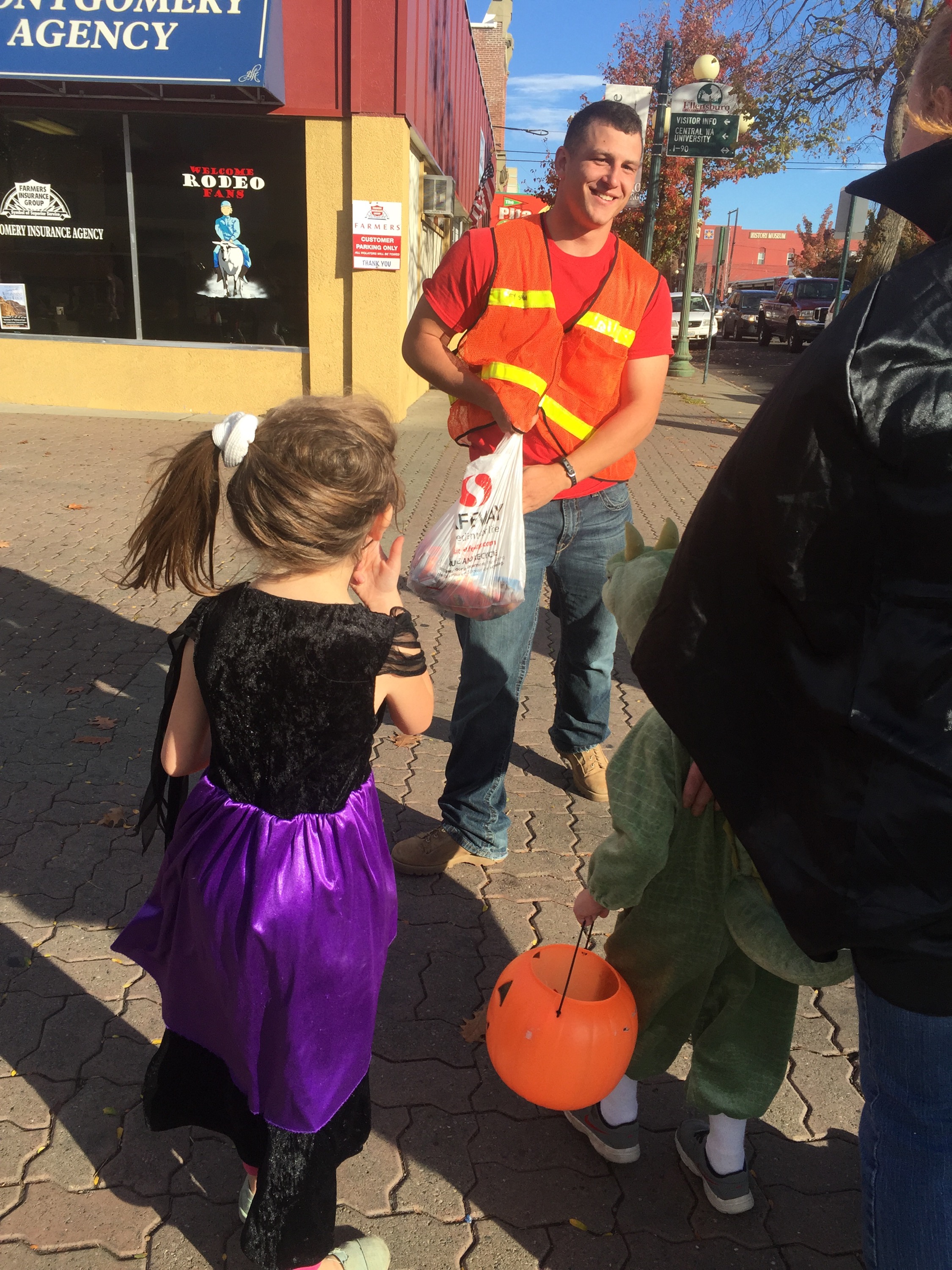
Heading east toward Yakima and Walla Walla, we checked out the large small town of Ellensburg. It was the Friday before Halloween and businesses were handing out candy. You could get a real feel for the community spirit in this town as nearly every IMG_2903business in their large district was participating. The ROTC class from the local high school served as safety patrol (and handed out candy themselves.) They have a large county historical museum where I tried to learn how to pronounce the county name-Kittitas. I also learned there the town’s name used to be spelled Ellensburgh, but in 1890 The US Board of Geographic Names made every town with a “burgh” drop the “h” (apparently Pittsburgh rebelled.)

We thought it wise to park ourselves for the evening at a winery via Harvest Host, given Washington’s excellent wine scene. We picked White Heron Cellars partially because it is a bit north of where we were headed and would allow us to see a different part of the region, and partially because it was in Quincy, WA and I have a friend named Quincy! See hoIMG_2936w frivolous one can be on a year long trip? Indeed White Heron was beautifully situated on the Columbia River, though we had to take a circuitous route there. The winds were high and Cameron the proprietor said that there had been a fire previously this year adjacent to I-90 and trucks (and trailers???) just couldn’t travel safely–too many tumbleweeds. We loved all their wine and bought not one but two bottles, a red (a blend, Mariposa) and a white (Roussane). The next morning #visitorkitty got as far inside (which is to say just to the front step) of the Airstream as any kitty has thus far.

From there we headed to Walla Walla. When Ben and I got married, we had to look around for an officiant. A fortuitous serious of events led us to Rev. Jack Mathison – a World War II vet and otherwise amazing person who has remained a family friend. Jack trained as a navigator on the B-24 Liberator in Walla Walla, and we were headed there to see what we could see and share with him.

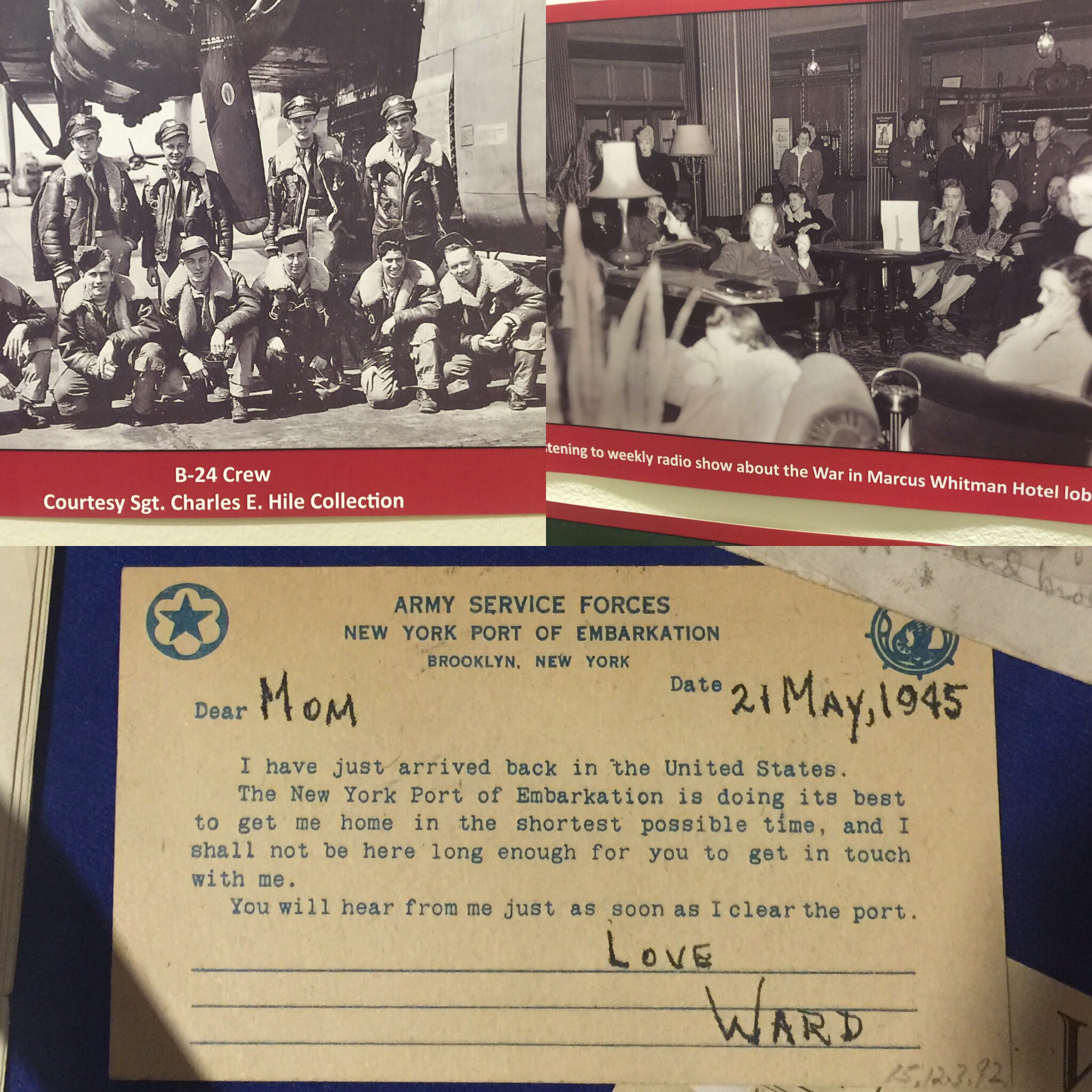
The excellent Ft. Walla Walla Museum had the goods. When we sent Jack some of these pictures, he replied saying he had spent some memorable evenings at the Marcus Whitman Hotel Café, and it’s where he started and perfected his Mark Twain yell:  “Mark .. TWAIN!”  Love him.

Jack told us about preprinted messages home like the one in the bottom of this pic. Easier to get past the censors! And it did take a while to get them home after the war had ended.

Jack told us about preprinted messages home like the one in the bottom of this pic. Easier to get past the censors! And for various reasons it took a while to get the troops home after the war ended. (For his part, Jack’s return home was delayed at least a month, as he had to spend time “fattening up” at Camp Lucky Strike in Europe following his liberation from a German POW camp, where he spent a hungry year after his B-24 was shot down.)

Walla Walla is deep into Lewis & Clark country as well. A local guidebook indicates that most of the places they camped or referenced were now hidden away under lakes and reservoirs created by the dams in the Columbia River. Oh what L & C would have done for a leisurely stroll across a lake! Of course the ensuing settlers and railroad and mining led the US government to negotiate, push, provoke, swindle and otherwise take land from the many Cascades Indian tribes, including the Walla Walla. Chief Peopeomoxmox, seen below left, actually stood up to the territorial governor and won some concessions in 1855; he secured additional lands, allowing more tribes to stay on at least some of their home lands (see the three reservations below, i.e. rather than one or two). In the scheme of things it was a small victory, but it stuck with me.

IMG_3084

Walla Walla is at the center of the lands of several Cascades tribes

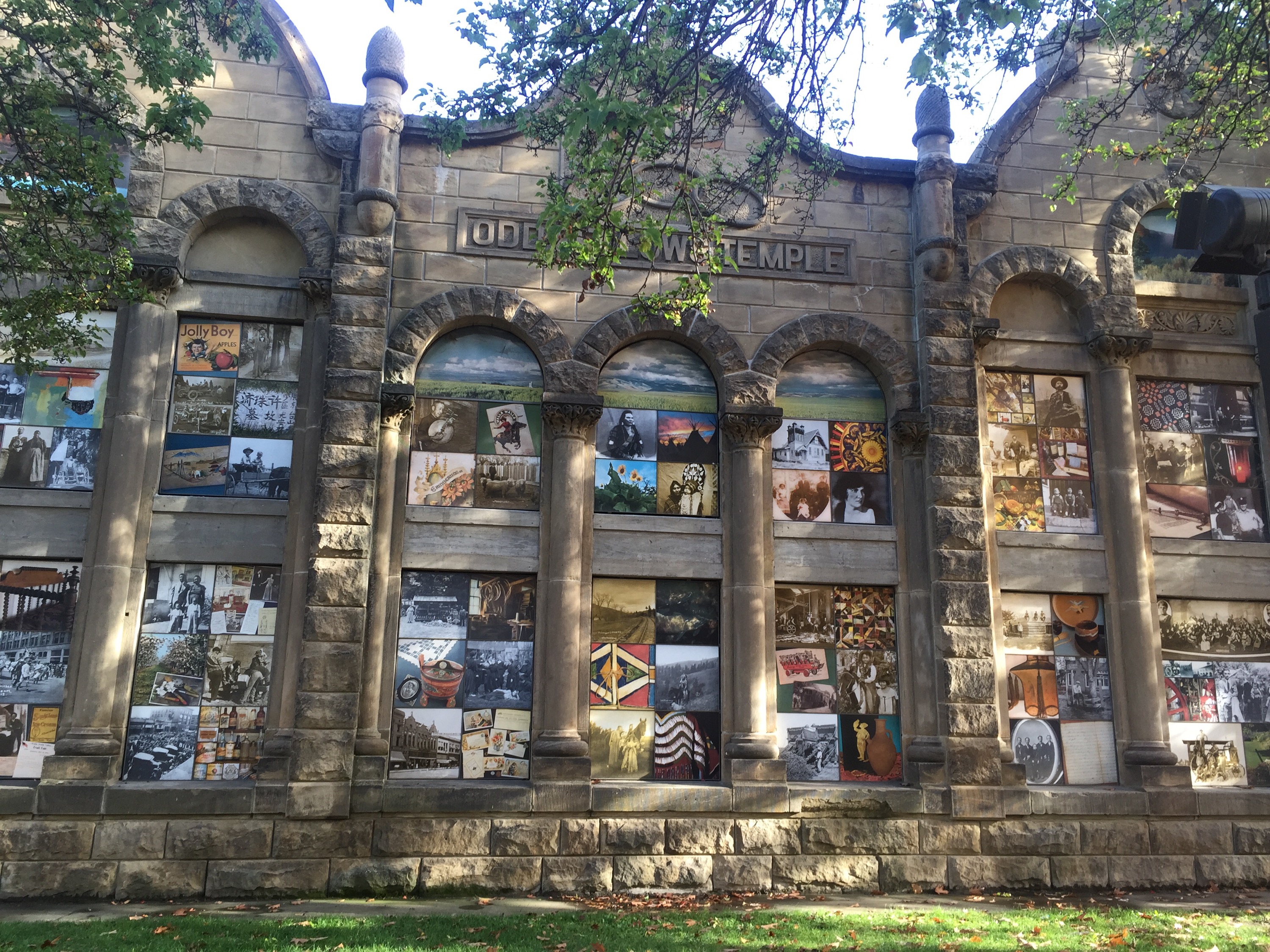
Walla Walla has become quite the wine-focused destination in the last 10-15 years. We spent Halloween evening there – in the Elks parking lot bless their hearts – and it rained. Such a bummer for the kids! We loved the scenes of Walla Walla people and culture over time depicted in “Windows on the Past” – the carefully preserved Odd Fellows Temple sandstone façade. Did you know Adam West (Batman!) grew up here?! Pop culture is important to trace as well.

IMG_2980

After Walla Walla, we headed toward the Columbia Gorge town of The Dalles (still can’t pronounce it.) We visited the excellent Columbia Gorge Discovery Center and the folks there were kind enough to let us park and stay overnight in their lot. The area along the river there is also a trailhead for area walking/biking trails and there were lots of locals coming and going to make use of them. The staff person who oriented us to the exhibits, knowing we only had a short time, suggested we take a close look at the basket exhibit. She said of course you will see baskets at other museums, but in this exhibit she felt like she really learned and was surprised by some of their uses. (For example, upper right, those baskets were used as hats!)

IMG_3086

Scenes inside and out of the Columbia Gorge Discovery Center

The next morning we did a quick hit on Hood River – daylight savings time had ended and we for oIMG_3037nce were up and out early – almost too early for any stores to be open. But we did see Hood River is home to one of our IMG_3039favorite beers (Full Sail, left).

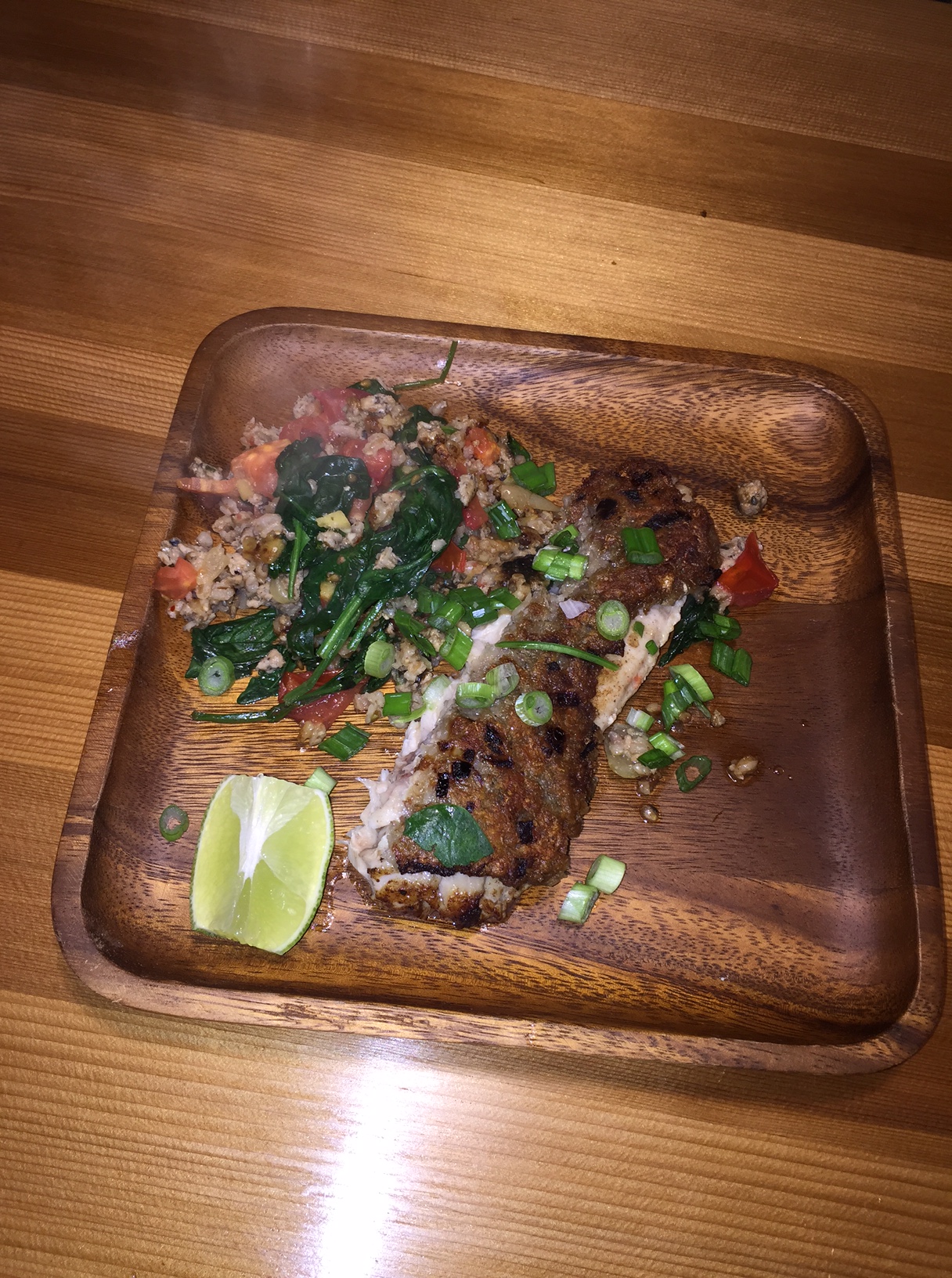
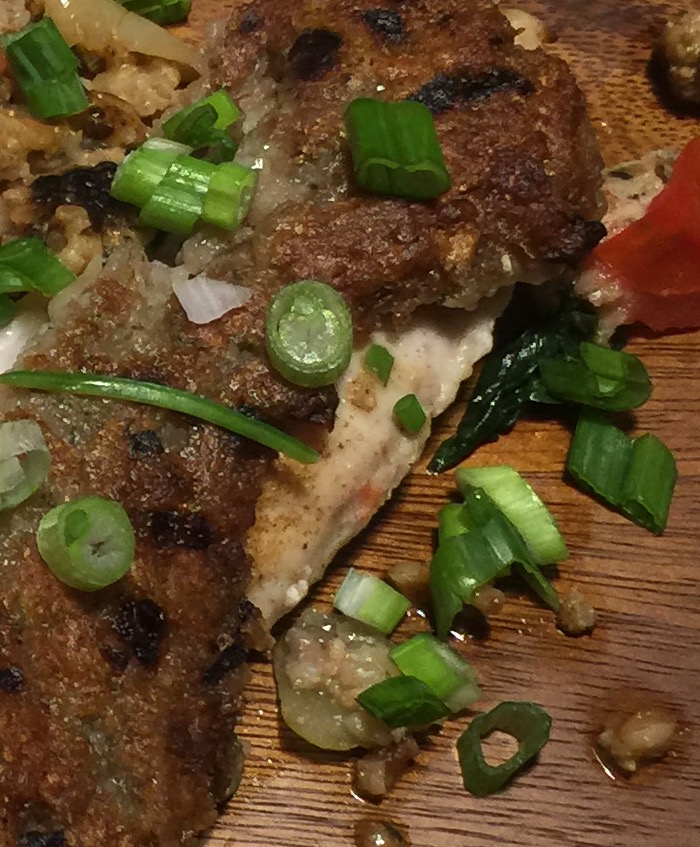
And I browsed their local book store and saw this on sale – photographs taken by the excellent Molly Peterson, a good friend and former colleague of my good friend Pam. Kind of cool to see it out here in the wild! Any food picture taking tips I have learned from Pam, Pam has learned from Molly, so thank you Molly! And with that, I will leave you with a potato encrusted red snapper, which I believe I made in the enchanted forest adjacent to Mt. Rainier last week. Pam’s tip to me (and I assume Molly’s to her) is to zoom in, give your picture a focus, which I did below for the picture on the right.

To test my theory, I asked Grier, who is sitting next to me, which of the pics was more interesting/engaging and she said the right one BUT she noted she is not sure she can tell what the food itself is (eg fish, potato, etc). GooFullSizeRenderd feedback for next time!!!IMG_2875


TBT 1980 and 8th Grade Science Class – Mount St. Helens on a Very Clear Day

We spent a lovely long weekend in Seattle with friends new and old, enjoying our first days in a REAL bed since our trip began almost two months ago. We headed to Mount St. Helens – that perfect mix of history, nature, and places we might never get to in a world of limited vacation time. Though we’d heard enough from Seattle-ites about the wonderful precious mountain views that only come “on your tiptoes during full moons when the breeze is blowing just so, and a black cat hasn’t crossed your path, etc”, we were pretty blown away by this view of Mt. Rainier on our way out of town, south on 5. A foreshadowing of spectacular sights to come…

Mt. Rainier, on a unusually clear day, heading south from Seattle on THE 5!

Mt. Rainier, on a unusually clear day, heading south from Seattle on THE 5!

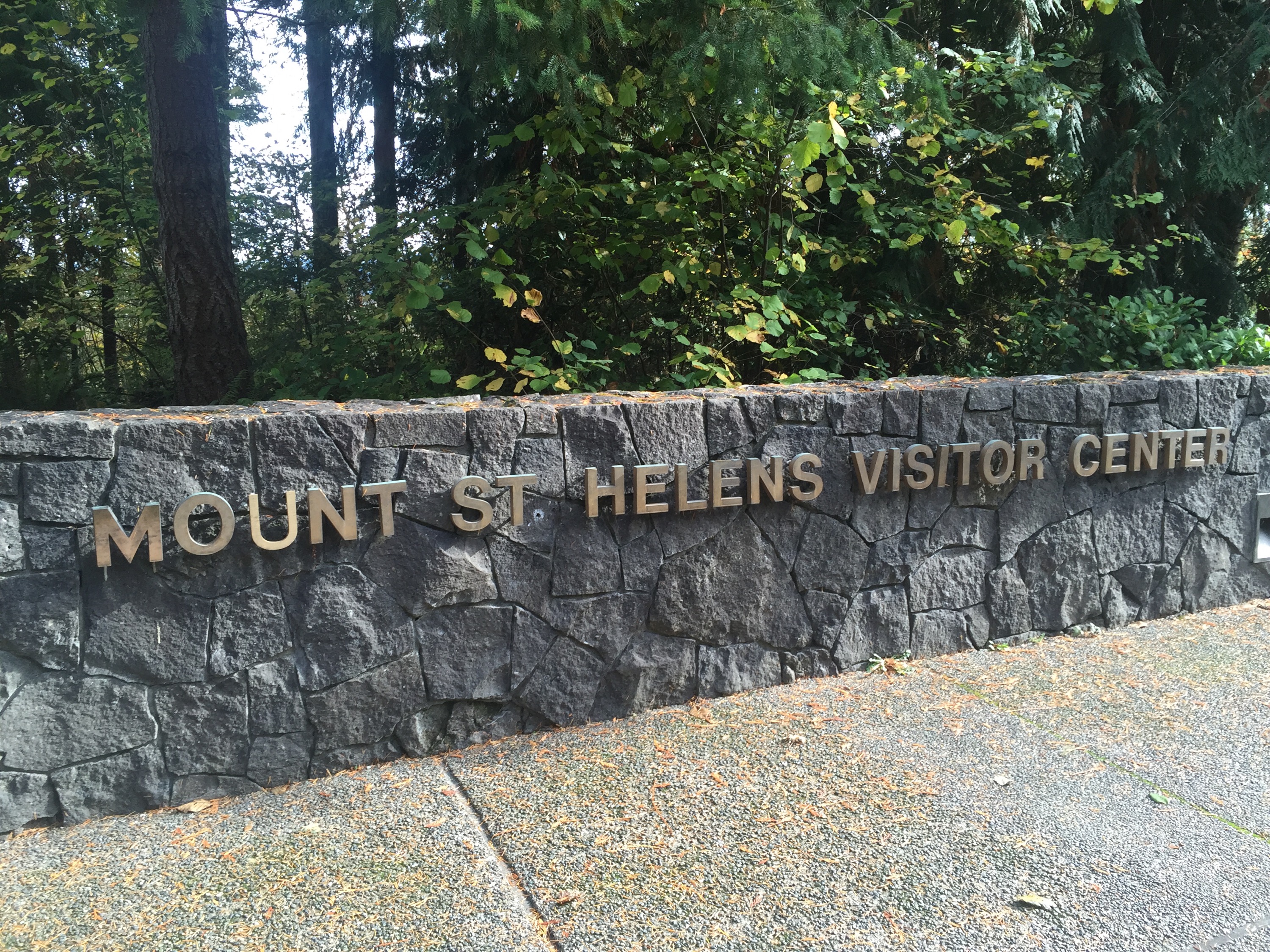
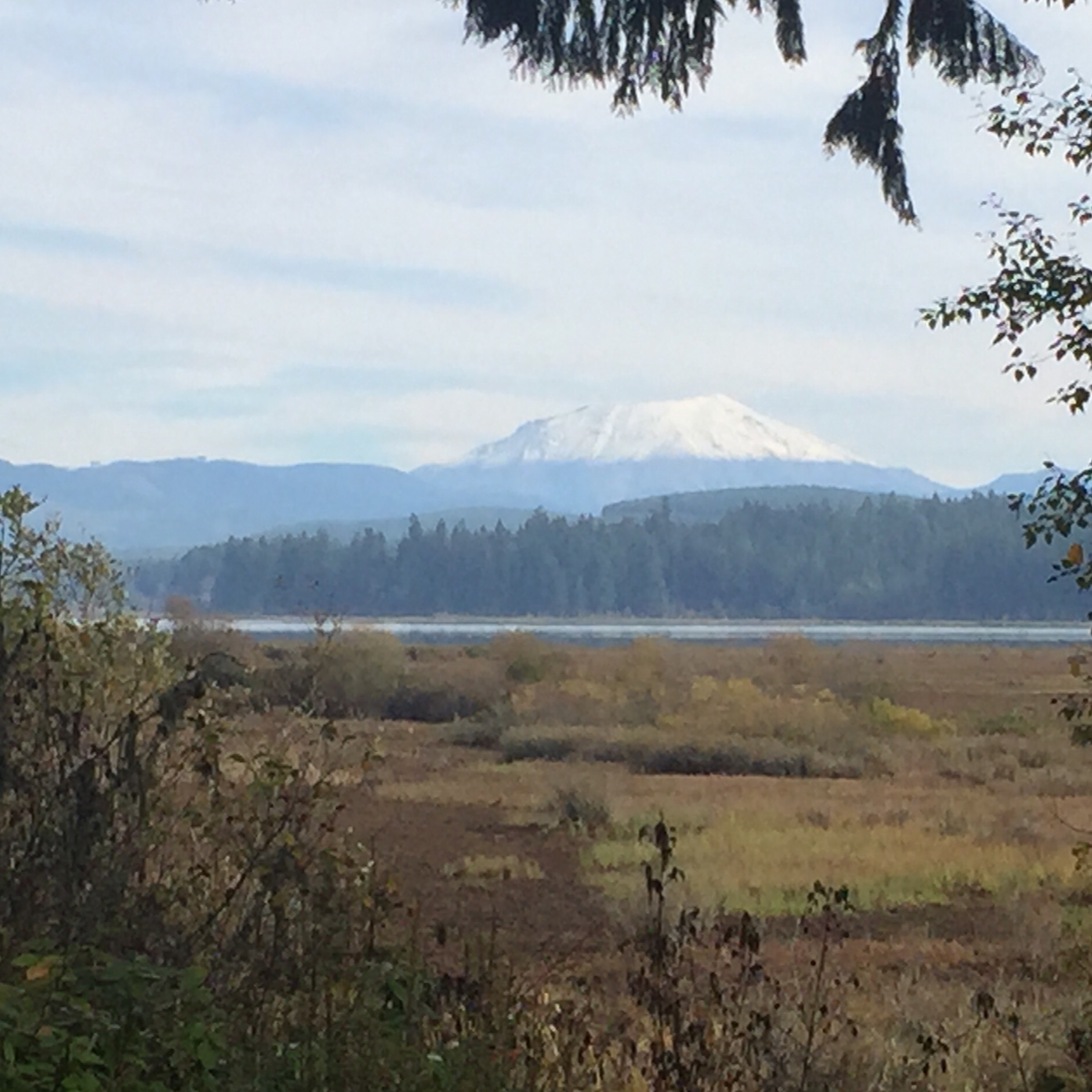
Soon we were in the land of volcanoes, many active in the Cascades regIMG_2685ion (being so close to those Pacific faults you know), and one famously so 35 years ago, Mount St. Helens. Though we both remember the eruption, we don’t remember that there had been plenty of warning (seismic, geysers, a bulge on the northwest side that grew five feet(!) a day) that a major volcanic event was coming, and that somehow made the human story behind what happened here even more compelling today. The weather held and we were greeted with this view when we arrived at the Visitor Center at Silver Lake. It’s in an area northwest of the mountain which was devastated by the eruption. The exhibits there focus on the impact on the local community.

IMG_2686The staff there suggested (thankfully!) that we hightail it to the Johnston Ridge Observatory — about 50 miles west — for a closer look at the mountain and to take advantage of the spectacular visibility, which weather reports suggested would not be coming again any time soon. Plus. the observatory is only open seasonally and closing in a few days. We made plans to return to this VC the next day and headed up the mountain.

About halfway up to Johnston Observatory - elevation not too bad for towing the Airstream.  I believe that is Mt. Baker to the left.

About halfway up to Johnston Observatory – elevation not too bad for towing the Airstream but these viewpoints are convenient to give the truck a rest. I believe the snowy peak to the left is Mt. Baker..

Johnston Observatory , 5 miles from the summit, is named for David Johnston, a 30 year old (!) volcanologist working with the U.S. Geological Survey (USGS) who died in the eruption. He is credited with saving hundreds/thousands of lives because of his warnings about the danger based IMG_2744on the readings off the mountains they were getting in the weeks and days before May 18th, 1980. Though the area around there isn’t widely populated, it is/was a popular summer destination, with cabins, lakes, camping, etc. Police had set up checkpoints all around keeping people out on the advice of people like Johnston. You can imagine, especially with the run up to summer, the pressure from residents, business owners and others. This exhibit panel to the right from the Silver Lake Visitors Center tells some of that tale.

The eruption itself happened on a Sunday morning, at 0832. The day before, police had escorted anxious property owners in and out for quick checks and to retrieve belongings – folks had been barred from visiting their homes since March, when the first eruptions occurred!. Officials were planning to allow homeowners to briefly return again on Sunday. That morning, David Johnston was at his observation post, located about where the Observatory is today. His final recorded words came as he urgently radioed USGS headquarters in nearby Vancouver, WA …“Vancouver, Vancouver, this is it!” The eruption began as a lateral eruption – just like it sounds – the mountain blew up sideways. Because it is so unusual, it was unexpected, even to the scientists. These pictures were taken by a camper who just happened to have the perfect vantage point – and hightailed it away with his life. We camped here the second night.

From Bear Meadow pull out off 99 on the east side of the park.

From Bear Meadow pull-out off 99 on the east side of the park. Pictures taken by Gary Rosenquist, a private citizen who chose this camping spot that weekend, hoping but not nearly being able to predict that he’d get pictures like these. 

Then, later, the 12 mile high eruption. This postcard below is going to my nephew, but for now, please enjoy. Unbelievable.
IMG_2944

David Johnston’s body has never been found. 56 other people died.

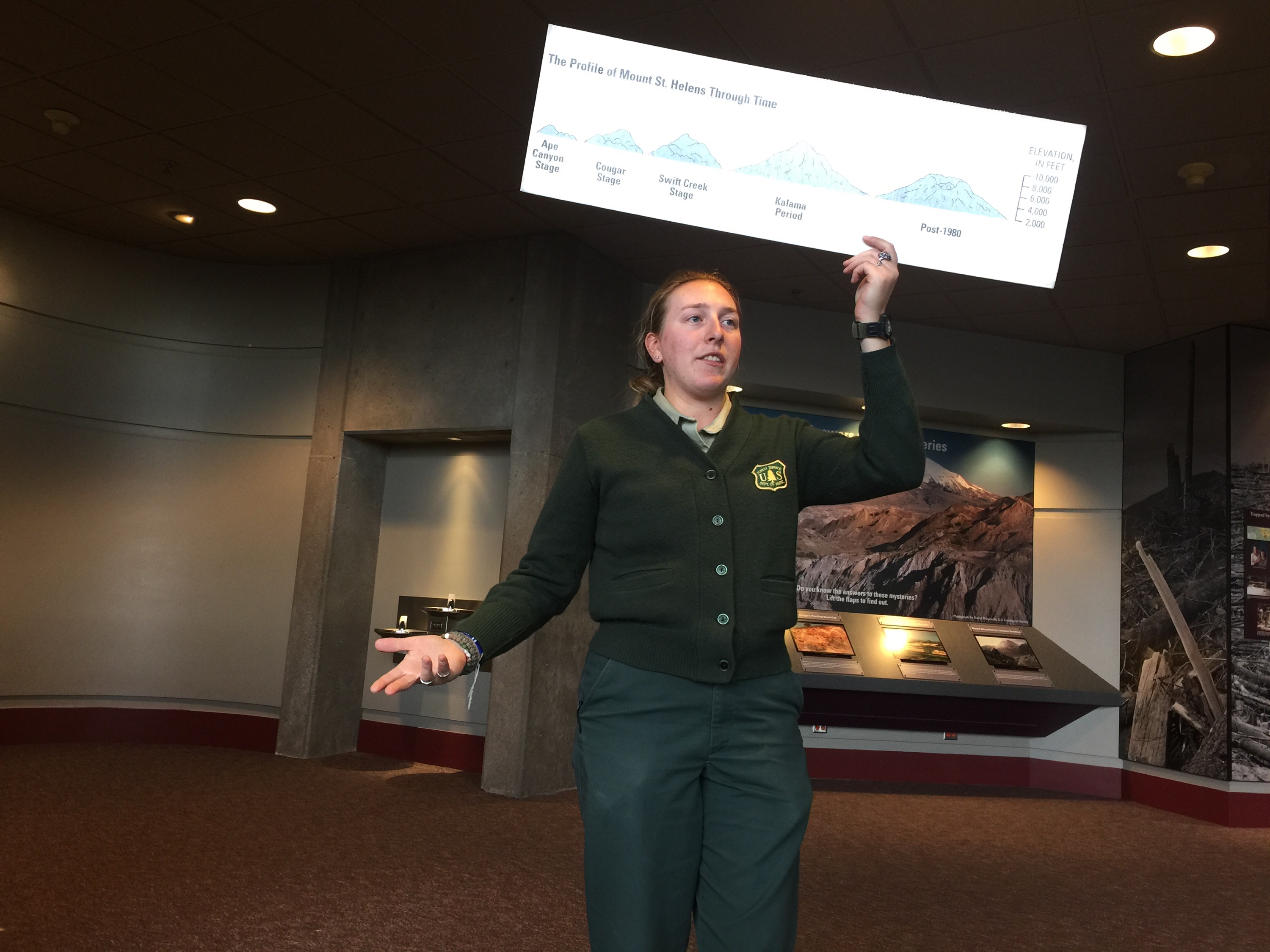
The Observatory had an excellent trail outside which we braved in very high and very cold winds. Inside, in an excellent ranger talk, we learned how and why the lava coming out of MSH is more like mud balls compared to the syrupy flow of those in Hawaii (if I have my notes right it’s because of silica content of the magma).

IMG_2717

Mt. St. Helens is actually relatively young for a mountain in this region. And, it is still an active volcano.

The tree below shows the impact of the blast (left side) and the protected side (right). Good bye park. Some mountains facing the eruption were blasted down to bedrock. Nearly 150 square miles of forest were either blown down completely or killed. The pics are incredible – miles and miles of what look like matchsticks blown over in the direction of the 300 mile per hour blast.IMG_2721

We camped that night in Harry Gardner County Park, newly reopened after 35 years. The whole area adjacent to the Toutle River was swamped by mudflow coming out of the eruption. From what we could gather, Cowlitz County citizens led the effort to get this park back to it’s beautiful condition today. Way to go.

We headed to the south and east sides of the mountain to do some short hikes and see how the eruption did or did not affect various terrains. The south part of the park did not take a direct blow in 1980, but the Trail of Two Forests there shows impact of previous eruptions. While there, an 8th grade class from Camas, WA descended (crazy because we had felt like the only people on the mountain previously) to check out what they’d been learning about in class. Their teacher was awesome! The middle picture below shows the holes left behind when lava encased a tree trunk, then cooled; when the tree rotted or burned away, it left the holes.

Later, we ventured north to the east side of the mountain. Here the views and signage really give you a feel for the incredible effort and payoff of the recovery post-eruption. They are learning so much about how a natural area recovers from such events, trying out different methods of replanting, and of course keeping timber growing and available for lumber companies.

IMG_2763

We hiked the Harmony Trail – highly recommended. It leads a mile down to Spirit Lake. Immediately after the eruption, the lake was said to have “disappeared”. If you were a girl or boy scout in this area, you surely would have camped on Spirit Lake. Imagine the devastation as the volcano’s explosion blasted water out of the lake and onto the adjacent mountain sides leveling the forest, then retreated back into the lake, carrying all the tree trunks with it. This area is truly sacred – picture this whole basin filled with mudflow and debris; now the lake is intact, but on its surface floats the remnants of an entire forest felled by the blast. We were lucky enough to be the only ones there when we visited, adding to the experience. At least one life lost here was Harry Truman – an 80-something lodge owner who refused to leave the mountain with his 16 cats, despite pleas from his neighbors and a letter-writing effort by local school kids.
This final picture (from the Observatory) is a neat trick the ranger showed us – my hands show what the summit looked like before the eruption. IMG_2720

After this incredible trip, we headed just north to Mt. Rainier. And tucking into an excellent camping spot in the adjacent national forest, the rain and cold was just too much for us to do more than (enjoy a) drive through the park – next time! We hear there is sun on the east side of these mountains…

The Great Divide

Though we had both read Undaunted Courage by Stephen Ambrose some years back, now that we were in the thick of Lewis and Clark historical country here in Idaho, it was time for a major review.

Spoiler Alert - that's Meg at the top of Lemhi Pass

Spoiler Alert – that’s Meg at the top of Lemhi Pass

Meg bought a used copy, spent an evening or two in secluded study, then thoroughly briefed me – including long passages read verbatim – as we spent 2 1/2 hours on the road east to Lemhi Pass from our campsite on the Salmon River near Stanely, ID.

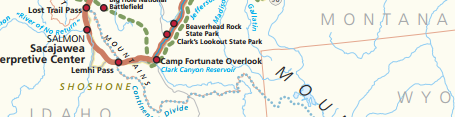
Lewis and Clark’s inaugural epic journey (see our area of travel on the left in the NPS map close up below) of course would have been from the east to the west.

NPS map of the area we visited

NPS map of the area we visited

This is beautiful country here in the Bitterroots of Idaho and it’s easy to visualize the events Meg is reading about and the country Lewis and Clark saw: rolling, grass-covered mountains periodically giving way to rocky cliffs and spires, and the Salmon River winding through all of it with waters alternating between rapids and smooth, but still fast, water and banks lined with the yellow/orange of Cottonwood trees reaching their peak now that it is (was) late September.

IMG_1472

Stephen Ambrose tells of how Thomas Jefferson, the real force behind the Lewis and Clark expedition, sent Lewis to be schooled by recognized experts in astronomy, botany, and other sciences so he would be as prepared as he could possibly be for his mission of discovery. Fascinating – it sounds like preparation for a space mission.

Suddenly Meg’s reading was interrupted as a magnificent Bighorn Sheep bounded across the road in front of us and I had to swerve to miss it. Fortunately, there were no other vehicles on the road; the scenery was utterly rural with few signs of human activity and we and the wildlife had the place to ourselves.

Interpretive trail at Sacajwea Center in Salmon, ID

Interpretive trail at Sacajwea Center in Salmon, ID

In Salmon, ID, we stopped at the Sacajawea Interpretive Center, which was closed, but we walked a mile or so through their very good outdoor exhibits: hay fields, replica tepees and sweat lodges and a streamside nature trail. The Interpretive Center is in the Lemhi valley, where Lewis and Clark went after crossing through Lemhi Pass. It is where Sacajawea’s people, the Shoshones lived part of each year, which made her valuable to the Corps of Discovery as a guide, and Ambrose surmises happy to return even under these circumstances, enslaved. We enjoyed this lovely setting, seeing the world through her eyes (she was captured at about age 12), with mountains in the distance, and the excellent exhibits about the natural world, the messiness of nature, the salmon lifecycle and the Shoshone life.

IMG_1424-0

Note, we did the reverse of Lewis and Clarks first trip, so another spoiler alert – they made it over the pass.

We got back on the empty highway leading west. The signs are small, and we almost missed the turnoff from the main road that led to the paved road leading to the rough dirt road that led to Lemhi Pass. One gets the feeling that only diehard Lewis and Clark nerds visit this place. But maybe it’s just that we’re here in the fall, after others have gone back to work and school. In any case, we began our ascent into the mountains past a few isolated ranches and some lovely cottonwood groves, pausing only briefly to let a herd of cattle pass in front ofIMG_1419-0
us, watching them get coaxed along by a pack of dogs and a couple of guys on ATVs.

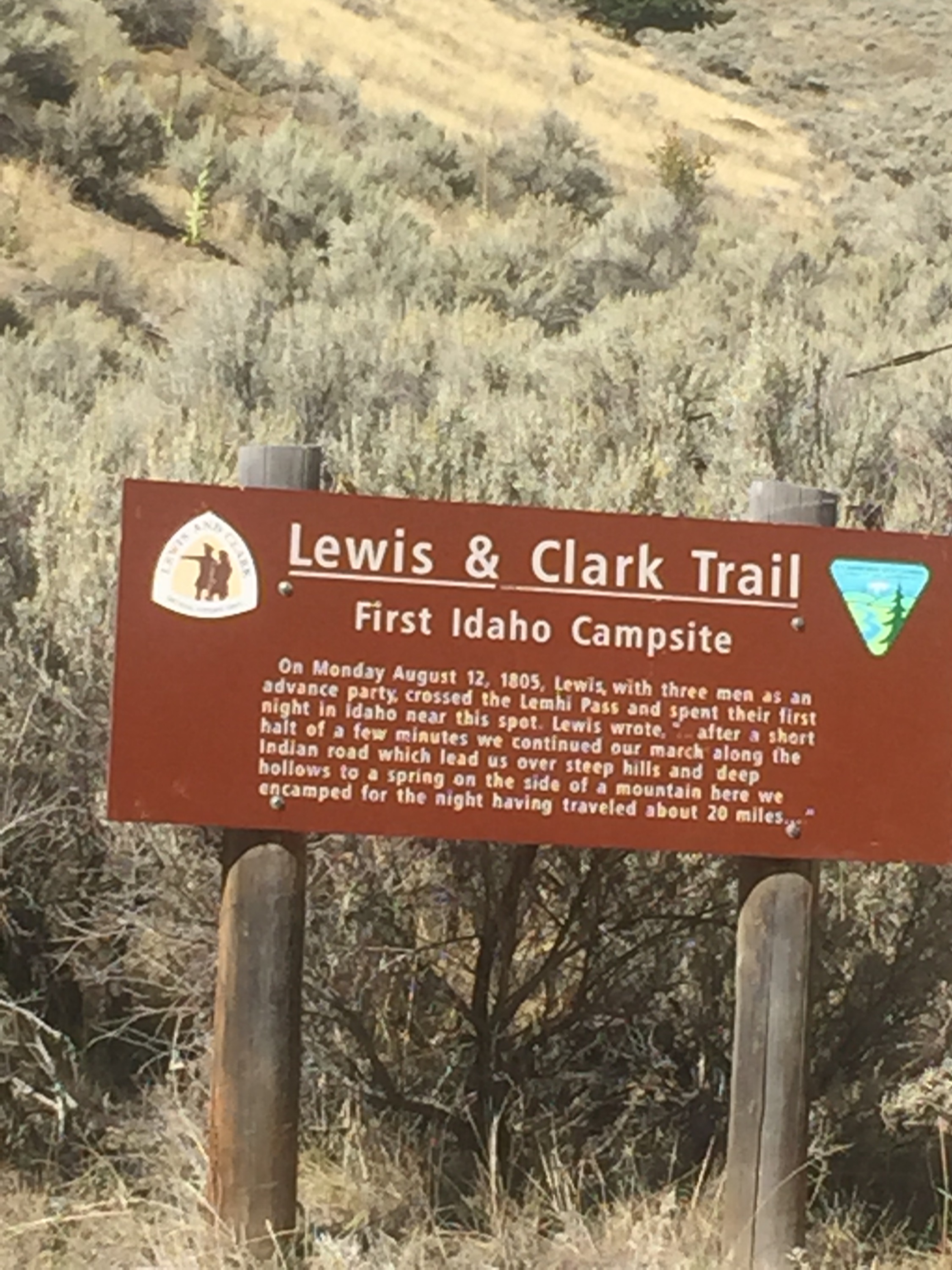
After perhaps 12 miles, we reached the top – Lemhi Pass and the Continental Divide, the geographical line to the east of which waters flow to the Gulf of Mexico, to the IMG_1439west of which waters flow to the Pacific Ocean. It was at this pass in August, 1805, that Meriwether Lewis and a couple of others from the exploration party reached the top and got their first view of the long-anticipated Columbia River flowing west to the Pacific Ocean. Or at least that’s what they thought they would see as they crested the hill.

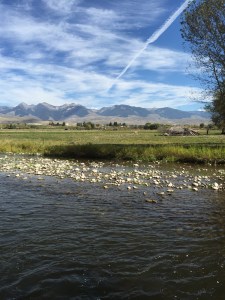
What they (and we) actually found on that hilltop was a lovely westward view of another mountain range, not the Columbia River Lewis and Clark hoped would complete their quest to find a navigable water route across the continent. For us, the view from the hilltop was sublime on this glorious autumn afternoon – rolling, grass covered hills in the foreground, magnificent mountains on the western horizon. For Meriwether Lewis, who had endured months of wilderness travel and was out of food, it must have been something altogether different. The Columbia River and an easy route to the Pacific wasn’t waiting for him; additional weeks of arduous travel wereIMG_1441

Remarkably, though, the view west from Lemhi Pass, the Great Divide itself, was essentially the same for us as it was for Meriwether Lewis! With the exception of the dirt road that led us to this spot, a distant power line or two, and the remarkably clean Forest Service pit toilet building off to the side, the scene was right out of the early 19th century. No visible development, no fences, no signs of humanity. Spectacular.

Lewis and Clark’s party had largely followed the Missouri River in their travels west from St. Louis, and Lewis was thrilled to locate the headwaters, or source, of the river here at Lemhi Pass. In his journal, Lewis talks of the “most distant fountain” of the Missouri, which he identified as a spring bubbling out of the ground about half a mile east of the top of the hill. We strolled down the dirt road and, sure enough, there

Missouri headwaters, likely the exact same puddle Lewis and Co exclaimed over

Missouri headwaters, likely the exact same puddle Lewis and Co exclaimed over

it was, surrounded by a rickety split rail fence (that we made easy work of). We both dipped our hands in the foot-wide spring (it was cold) and “straddled the mighty Missouri, one foot upon each bank”, as one of Lewis’ men took great pleasure in doing, and chronicling, 210 years ago.

Meg straddling the Missouri headwaters

Meg straddling the Missouri headwaters

Note: This was a guest post by Ben Barker who does not like to use exclamation points, or begin sentences with contractions. 

The Things We Learned in our FIrst Month Full-Timing – An Anniversary Tribute!

In honor of our one month-anniversary full timing in our 22-foot 1968 Airstream Safari, we present: Five things we know now! Or now know! A listsicle!

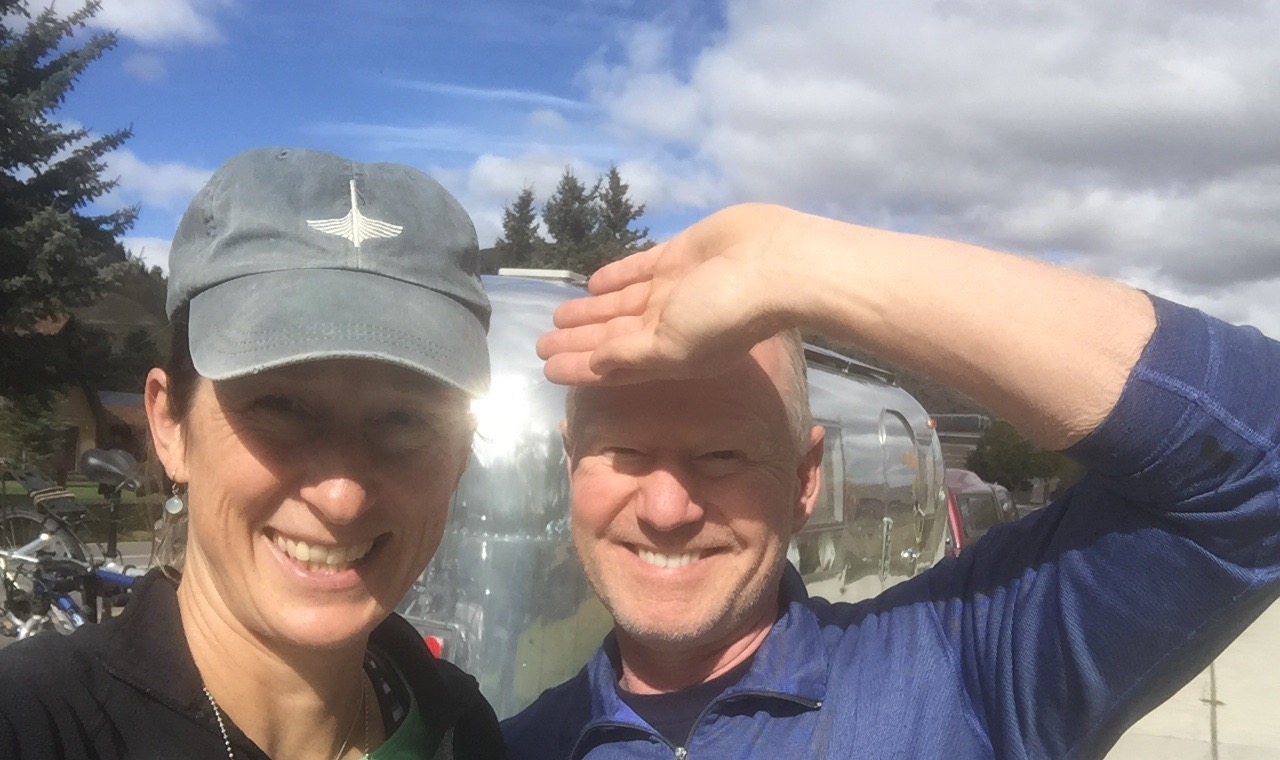
One month full-timing anniversary smiles - in Jackson, WY!

One month full-timing anniversary smiles – in Jackson, WY!

Some context: we spent almost two years on a shell-off renovation; we are taking “a break” from employment, so have time, but are on a $ budget as we travel. Also, we expect this list to be very different a month, two months, a year from now. We are still very new to this but have gone from zero to some knowledge and it has been interesting to compare what we expected to what has been reality, and we thought we’d share since we’ve learned so much from others who have.

1. The renovation was a success! Everything’s working, reliable. Now, part of me shies from making such a bold statement, for fear of jinxing. But it’s worth it to say

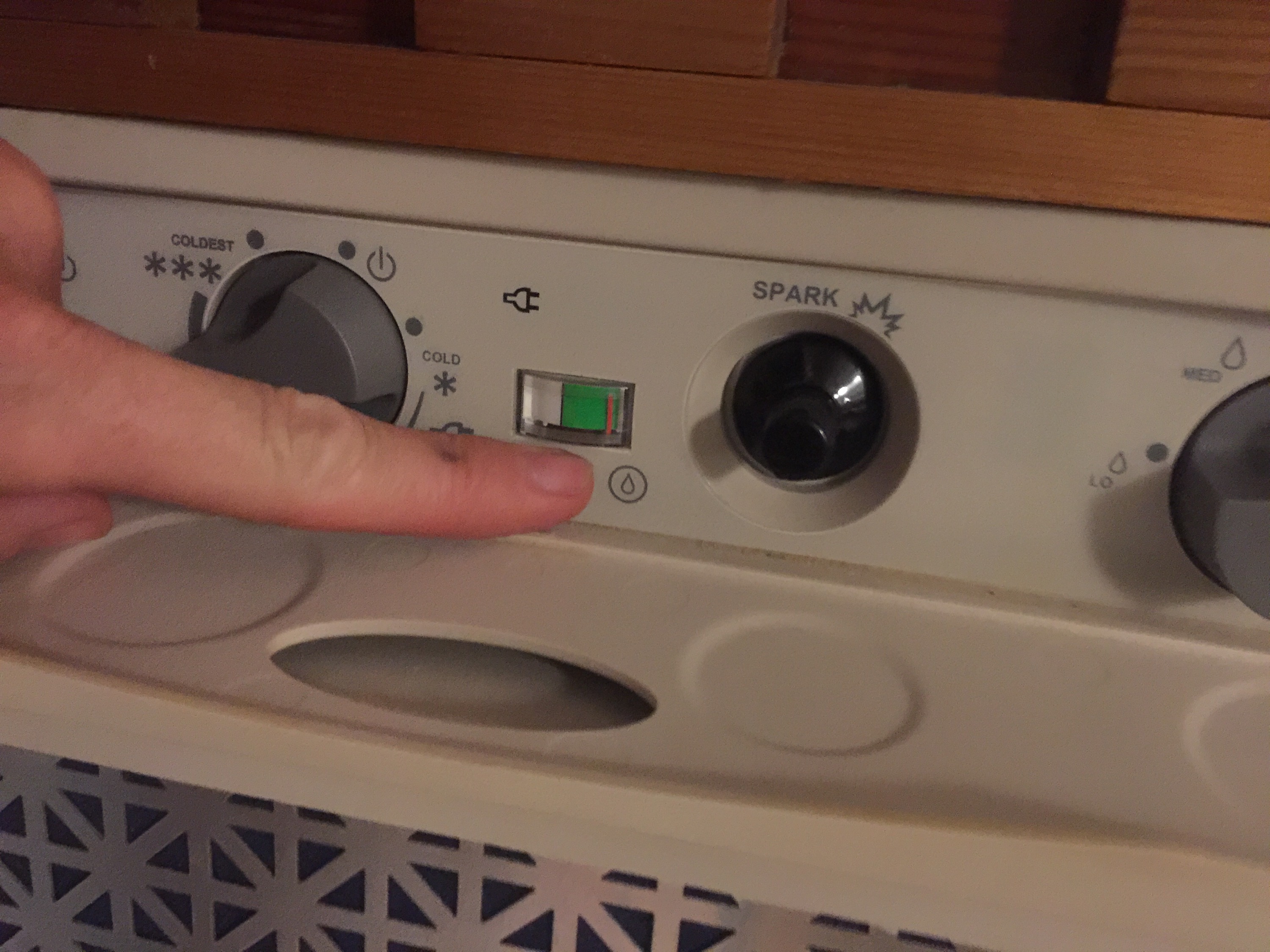
Red line in the green means the wine will be cold!

Red line in the green means the wine will be cold!

“hats off” to Ben and the sub-contractors who contributed their muscle and expertise. I get particularly goose-bumpy proud when we pull up to a campsite and I go through the simple three-step process to get the fridge going on propane – and it works!

2. Having made some careful considered investments up front, we are really enjoying the benefits of being able to “cut the cord” and exist (very comfortably) without hook ups. Two things in particular make this possible: the solar (four 100-watt panels) and the energy efficient on-demand water heater.

3. It’s possible to plan 24 hours or less in advance, especially off season. Websites, apps, social media, chats with locals, real life maps, our GPS have all contributed to helping us figure out where we want to go, how to get there and where to stay. That’s not to stay there haven’t been mistakes. The ones I hate the most involve bad directions and it’s 25 miles to the next turn-around. That’s not just a waste of time but precious gas. But we are always learning from our mistakes.

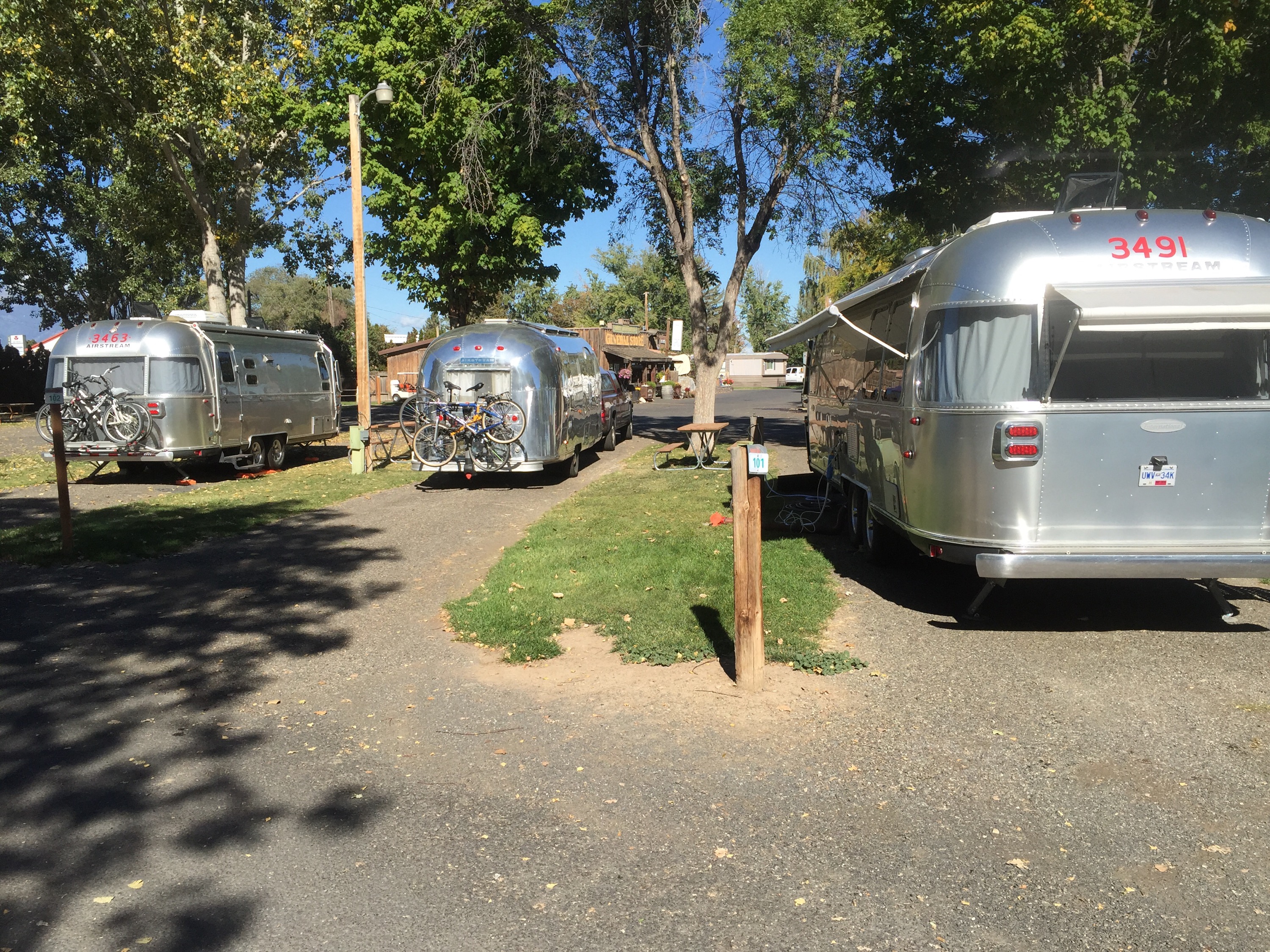
Mt. View RV Park was awesome!

Mt. View RV Park was awesome!

4. It’s more than okay to stay in an RV Park. As we were preparing for the trip, I loved reading about the boondocking, wild, off the grid adventures of the full timers out there. I romanticized that was the way to go. And of course the phrase “trailer park” comes with a lot of baggage. However, sometimes an RV Park really fits the bill: when you need wifi and/or a long hot shower being two reasons that come to mind immediately. Also, in our brief experience, sometimes, in order to save time and gas, an RV Park may be the best physical location for your goals. In cities (like Boise) and tourist hot spots (like the Redwoods) we found they were our most practical options. Plus they are generally staffed by awesome people as committed to your satisfaction as any fancy hotel concierge.

5. The percentage of our budget spent on various categories is not what I

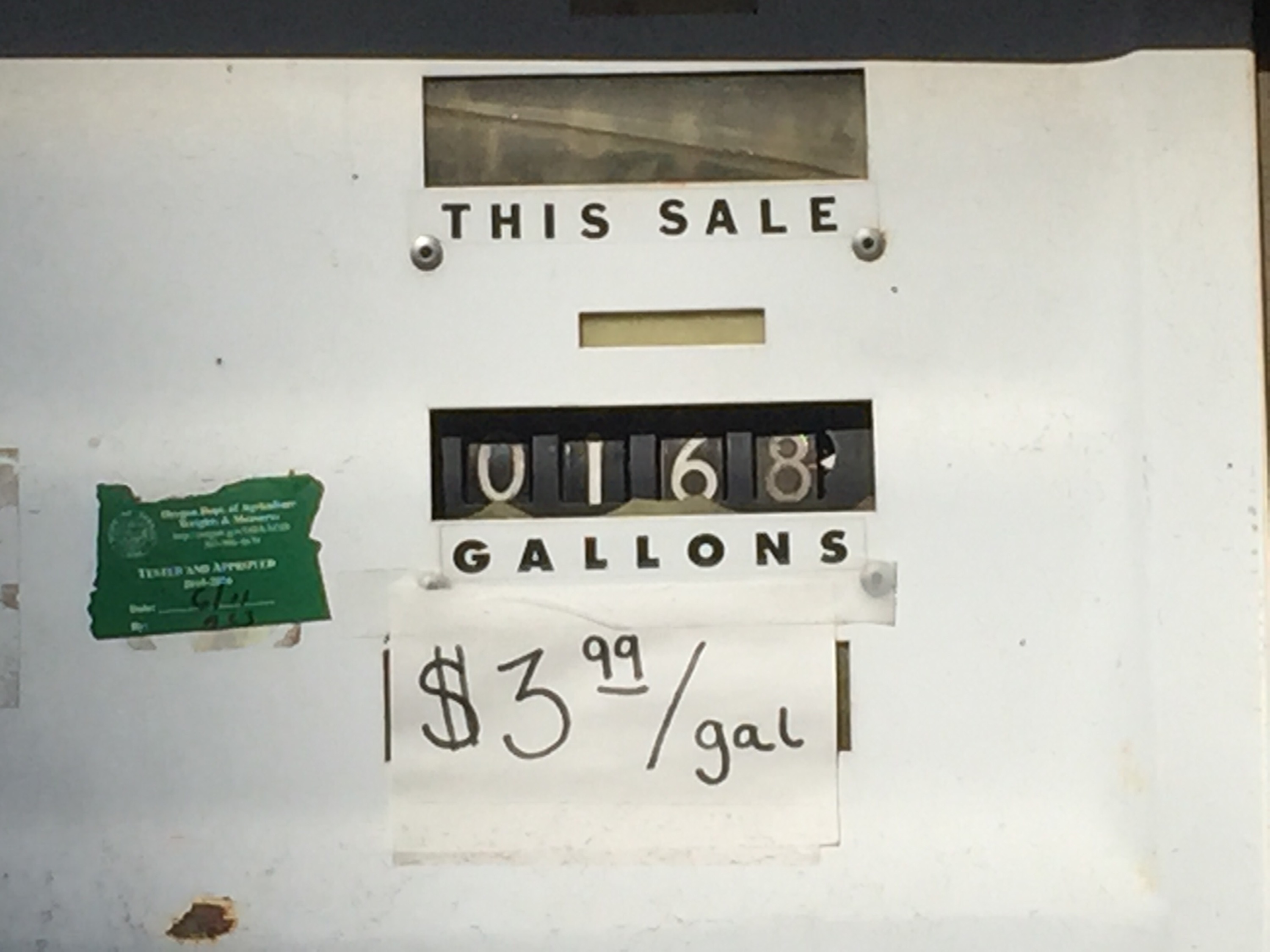
Gas, my budget nemesis

Gas, my budget nemesis

thought it would be. I thought our costs would roughly divide in thirds: transportation, food, and accommodations. However, we are spending way more on transportation, i.e., gas, than I anticipated. Don’t know why I’m surprised-we are averaging around 12 mpg and we have had a pretty ambitious route, leaving September 8th from California to get to Idaho, Wyoming, Montana before it got too cold. It does make us (me) pause to weigh gas costs (and wear and tear etc) into any pros/cons of a particular side trip, or scenic route. In the next month I think we will spend less on gas, and likely food too, as farmers market season winds down. We hardly spend anything on accommodations, i.e. overnight fees for camping. Maybe 10 bucks average, figuring in lots of free sites and the occasional 30 dollar RV park.

Some other thoughts we’d include if this was going to be a fifteen takeaways list:

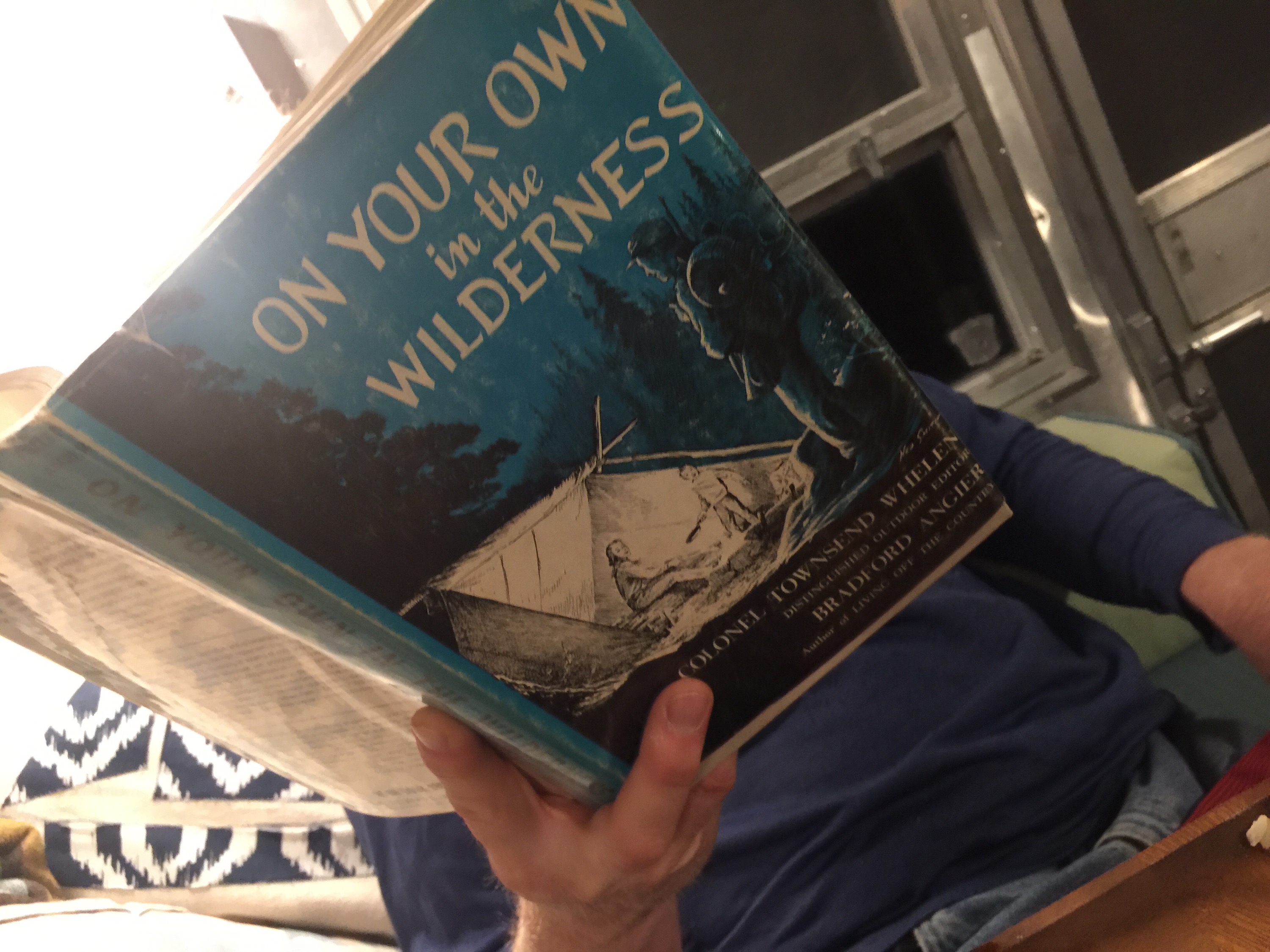
-We did not bring enough books – digital or otherwise; gotta have at least two in the queue ready to go at all times.

Picked this one up at used book store in Boise

Picked this one up at used book store in Boise

-I LOVE cooking with limited fridge/storage space. Forces me to use what I have and get more creative; cuts down on waste.

-I brought too many clothes. There is no need for a short-sleeve sweater. You know? However that second pair of sandals is coming in handy after this fox stole my Keen in the Tetons (no joke-we put the other one out to lure him back so we could find his hiding place. No luck).

-We started out with extreme discipline rolling up our bed (foam topper , sheets, pillows, comforter) and stashing it in the truck every day. Now we roll it up but keep it in the trailer, out of our way, but in your way if you came over for dinner and wanted to sit at our table with us.

Bed rolled up in back

Bed rolled up in back

-We have excellent places to stash stuff, but could probably use even more. The age old “where do you put the clothes you have worn once, but aren’t ready for the dirty clothes bin yet?” question hangs over us. Help?

-We love our truck, but if you are shopping, consider 3/4 ton with a standard bed. We have 1/2 ton, extended cab and long bed which complicates some of our maneuvers.

-15 GB of data was how much we used our first month. AT&T allowed us to up it from 10GB retroactively, which I appreciated! We need data for all that last minute planning, but I’m also a bit of a news junkie so someone else might do ok with less.

-We get so much joy out of flashing our America the Beautiful pass at the National Park entrance gates! Ours was a gift.

Just love flashing the pass at this booths!

Just love flashing the pass at this booths!

-It takes two people exactly one month to use a tube of Tom’s toothpaste!

-Composting toilets rock! And public bathrooms do too, if your other choice is a composting toilet.

One month anniversary truck clean out and reorg - nice scenery though!

One month anniversary truck clean out and reorg – nice scenery though!

Idaho Towns Round Up

What do Boise, Stanley, Ketchum, (and wild card) Driggs have in common? Are they index of town listed under Idaho in Lonely Planet’s USA? No! They are our itinerary of Idaho towns we stuck around in long enough to have some notes to share. And with the exception of Driggs, they are featured in Lonely Planet as well, so we’ll see what we can add to the well worn path…

Boise was the first big city we have set a spell in on this trip- and it was one we deliberately wanted to check out. We chose the Riverside RV Park because it’s adjacent to the Greenway, 25 miles of paths that go along the Boise River.

A piece of art depicting the Boise River, in progress of installation on a building downtown!

A piece of art depicting the Boise River, in progress of installation on a building downtown!

We planned to ride it into Boise the next day for an all day excursion, and so we drove into town our first afternoon to get a couple

Crowdsourced ideas for our visit!

Crowdsourced ideas for our visit!

bike parts and the lay of the land. I did a little crowd sourcing on Twitter – reaching out to Boise’s Visitor’s Bureau for suggestions – they replied! tagging others, which yielded even more ideas! Very cool.

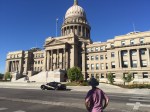
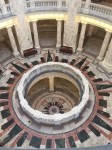
Our main stop that afternoon was the Idaho state capitol building. It has been renovated in the last 5 years and literally glistened, it was so shiny and new. It was fairly empty, but there were some friendly tour guides, and a gift shop filled with potato-themed souvenirs. Reading the displays, you might come away thinking this about Idaho: they are proud of their early adoption of women’s suffrage; land and water rights are what gets the citizens and legislature riled up; Lewis & Clark went there. We were blown away that we could walk right onto the floors of both the House and Senate chambers – they weren’t in session, but still.

We are a little short on reading material – didn’t really plan ahead on all the time to read we’d have on this trip! So we went to The Redisovered Bookshop where we picked up a used copy of Undaunted Courage (very handy for our travels-Lewis & Clark have been everywhere) and a tip on where to go for a snack and what to get there. Indeed we very much enjoyed the Classic Poutine at Bittercreek Alehouse. The fried potatoes came with chunks of roasted turkey – my friends know well that I’m not scared of any carbs that come with a side of protein.

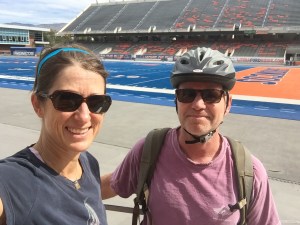
The next day we zoomed along the Greenway for the 10-mile ride intIMG_1340o town. The Greenway goes through neighborhoods,former industrial areas, under highways, a 9-11 memorial; even alongside a mini dam (see pic at right) that encourages kayakers and surfers to jump in and and catch some waves. We had to guess a bit as to where to “get off” but found ourselves exactly where we wanted to be: Boise State University, home of the blue turf. Ben has some PFGSD (post football game stress disorder) from some Fiesta Bowl when the Broncos beat his Sooners with a bunch of trick plays; nonetheless, we paid our tribute.

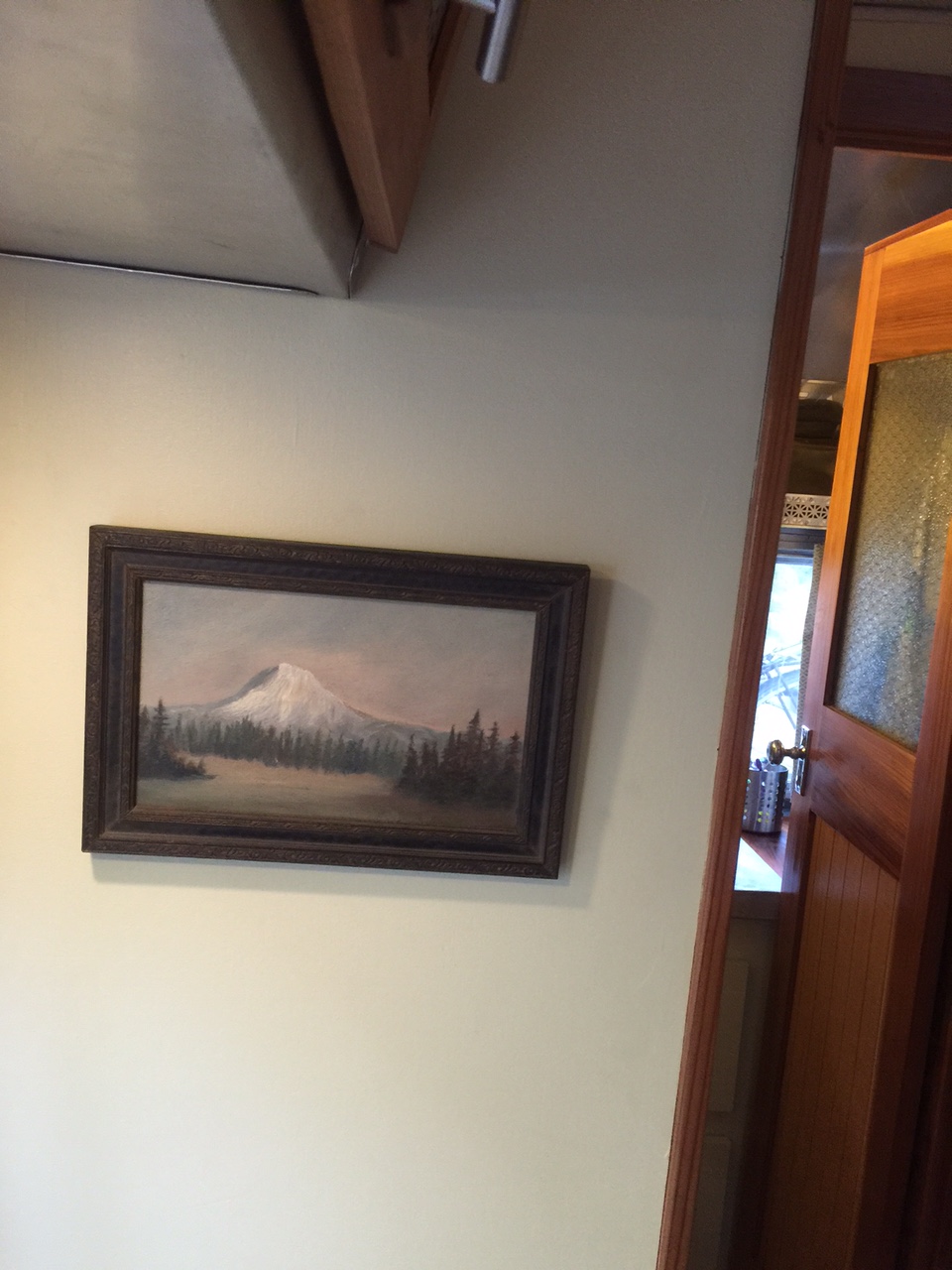
We roamed around the rest of the day – the history museum was closed, but the adjacent Rose Garden was lovely, we checked out the Basque block; the old (and hip yuppy) neighborhood Hyde Park where we very much enjoyed the dollar tacos at Parilla Grill. We checked out a few antique stores, picked up a few hooks, and this painting – our very first “art” for the Airstream. We just love it.

From a cool little store called "LA Junk"

From a cool little store called “LA Junk”

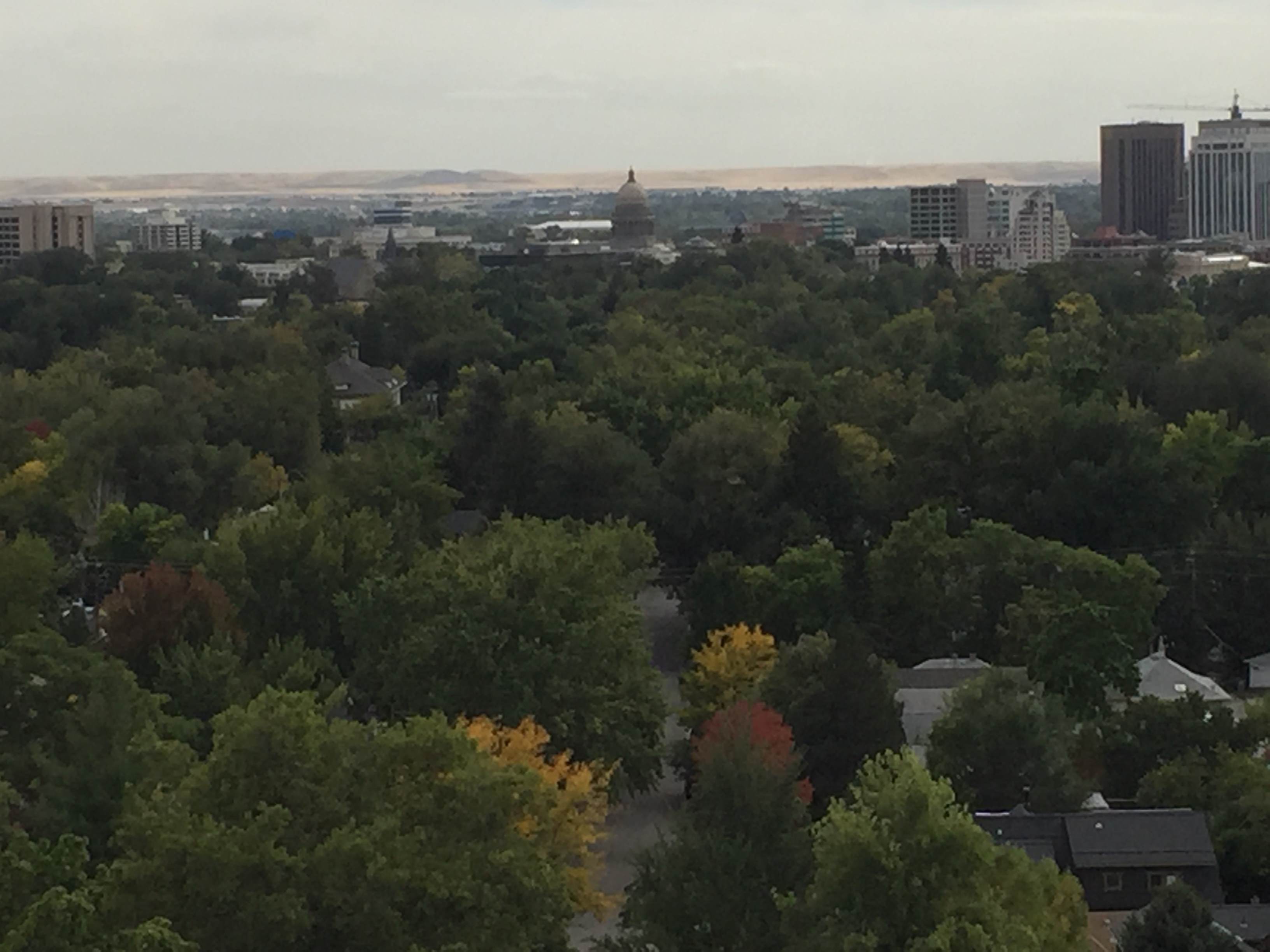
All in all, Boise was a very pleasant city – this view from the hill at Camel’s Back Park shows the inspiration for it’s name (French for “wooded”) and the beginnings of fall.

IMG_1333

On to Stanley – a cool little mountain town in the middle of the Sawtooth Mountains. Ellen at the Visitor’s Center steered us very well: we camped on the Salmon River just as the Forest Service was starting to shut down sites for the winter. Stanley apparently gets some of the coldest low temperatures in the continental US. (More about our campsite and an awesome day trip to Lemhi Pass in the next post…) IMG_1389Stanley had some well stocked outdoor stores, with sales that led to the purchase of this new hammock (left). We also had a culinary highlight – the Cowboy cookie (chocolate chips, walnuts, oatmeal) at the Stanley Bakery & Cafe, though their turkey sandwiches could have used a bit more meat. We checked out the Redfish Lake Lodge – which is a whole ‘nother world – kind of rustic fancy with a beach bar and scheduled activities. Not for us, but maybe you?

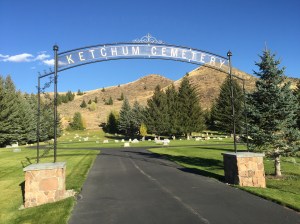
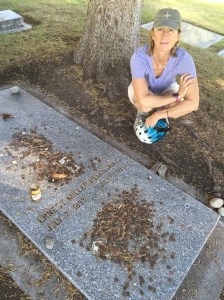
Ketchum and Sun Valley are just down the road from Stanley, an hour or so. We got a spot at the 10 dollar Forest Service campsite just a few days before camp host (crazy in a good way) Cathy heads south for the winter. We biked into town and explored a bit – disappointed mostly by the fancy stores selling the same overpriced coasters. Clearly the outdoors stores are gearing up for winter season – skiing and all. It took Lonely Planet to tell me Hemingway was buried here – his writing inspired

me to become an English major. Definitely a highlight of our visit to this city. Something that left us feeling UGH was the renovation of the Sun Valley Lodge – a historic building that now looks like any other Grand Hyatt. The concierge will emphasize how many treatment rooms the spa now has, however. Utterly stripped of personality. No picture will show the injustice. Will be interesting to see the reviews once the season starts.

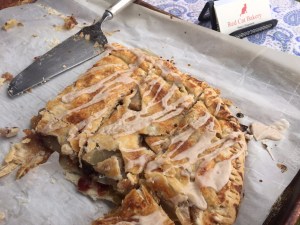
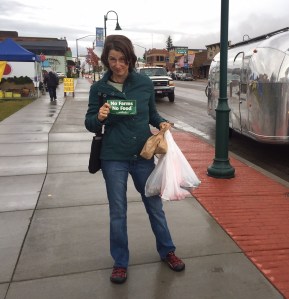
And finally Driggs! On the eastern edge of the state (we were headed to Wyoming) the town is the home of the Grand Teton Distillery on the Harvest Host list. The Distillery was so kind to let us park overnight in their driveway. Though we missed tasting their vodka (you know it’s made from potatoes!) and whiskey, we will look for it out on the trail. Though it was cloudy and drizzly and we had just been to the store, we saw a farmer’s market on the way out of town. “Do we have to stop?” asked Ben. AS IF! Luckily he gave two Airstream tours while I bought the last of summer’s

tomatoes, cucumbers, as well as jerusalem artichokes and this cherry slab pie (pictured above, though we liked her peach scone the most!) Driggs, we really liked you! The woman who grew the artichokes told me she’d give me this sticker (above right) if we put it on our Airstream. Heck, yes! They are continuing with a Teton Valley winter farmers market indoors, I heard. Hooray! Don’t forget to list and use Local Harvest in your travels to find local and lovingly grown food. For lovingly restored historic hotels, I can’t help you, but we have high hopes for our visit to Grand Tetons coming up next!